


Diversity and discrimination sensitivity must go hand in hand with a discourse critical of power within organisations.
The 15 participants in the Socius labor online event on 16 September 2021 largely agreed on this point. At the same time, it became clear in the predominantly white education group that the desire for a critical approach to power in order to achieve diversity- and discrimination-sensitive behaviour always begins with ourselves.
This is how our laboratory guest Hannah Gedamu also the headline: „Diversity is not about them. It's about you!“ chosen to make it clear from the outset that this laboratory is not about „the others“, but that we are working with ourselves.
Project on diversity-oriented human resources management
Hannah Gedamu works in Berlin for an association that promotes the professional participation of people with a (family) migration background and/or experiences of discrimination and supports organisations in the public and private sectors in becoming more diversity-oriented. The project she works on, „Diversity-oriented human resources work in Berlin's administration and companies“, has the overarching goal of increasing the proportion of people with a migration background and people affected by racism in Berlin's administration and companies. Hannah and her team support four selected Berlin authorities and companies in expanding their skills with regard to new tasks and challenges in the context of diversity and in fulfilling their legal mandates. The consulting services are tailored to the needs of the respective organisation and designed within the framework of cooperation. It includes advising and supporting the development of procedures and structures (especially in the area of human resources) to increase the proportion of people with a migration background in the organisations, training courses, workshops and individual coaching on various aspects of diversity-oriented organisational development for managers and employees, and networking with migrant organisations. The advice is provided in close cooperation with steering groups in the individual authorities, which were set up for the project.
Hannah backed up the necessity of her work with figures: according to a representative survey, only 12 per cent of employees in the federal administration have a migrant background; according to a pilot survey Only 3 per cent of employees in management positions in the Berlin administration are people of colour. We quickly realised what a mammoth task still lay ahead of us in terms of development and change.
In her input, she pointed out that her work is not so much about raising awareness among individuals, even though her team conducts critical whiteness training on an ad hoc basis and where necessary as part of their consulting services, but rather about Prevention and elimination of discrimination and promoting a culture of appreciation for diversity as a guiding principle throughout selected measures in the four authorities. Hannah reported on consulting processes that focus, for example, on embedding diversity competencies in job profiles and personnel development measures for managers in order to break the constantly repeating cycles of “the system reproduces itself” (white, cis, able-bodied). In this context, she also mentioned a number of other measures, such as the “Candidate Journey”, which analyses the path of an applicant from the first point of contact with an organisation to the completion of the application process on the basis of selected sample positions, and subsequently prepares expert reports and makes recommendations. This assessment includes the analysis of job advertisements, starting profiles, internal guidelines for the recruitment process, guidelines for selection tools and correspondence with applicants.
Allyship
After approaching the subject with questions and answers, we turned to the so-called „Allyship“To: the alliances that people with more privileges can form with people with fewer privileges.
In this context, it is particularly important to always remain aware that allyship is a decision that I, as a privileged person, can also give up (i.e. „being an ally“ is in itself a privilege), whereas if I am a person who is the target of discrimination, I have no choice as to when I move within the „dimensions of diversity“.
In the laboratory, we focused primarily on three questions relating to allyship in breakout sessions:
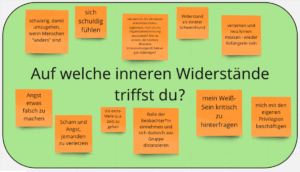
- What inner resistance do you encounter when you want to be an ally?
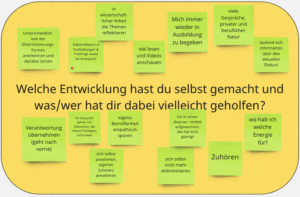
- What progress have you made in your allyship, and what has helped you?
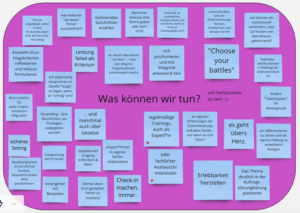
- What can we do (to be allies)?
final round
After this extensive collection, our time in the laboratory was almost over, but fortunately we still had enough time for a final round, in which we asked four more questions:
- What are you taking with you?
- What idea has sprouted in you today?
- What do you advocate for in your work context?
- What else do you want to learn?
A particular highlight here was the consistent desire to continue the exchange and initiate joint meetings to discuss what has matured today. We will be happy to invite you to these in November.
We were delighted that everyone present was so keen to continue engaging with each other in a self-critical manner.
 Deutsch
  English (UK)