


 Many years ago, I met Ines Boban, an expert in inclusion, at Matthias zur Bonsens' learning forum in Oberursel. At the time, she was working with her husband, Prof. Andreas Hinz, in Halle. Last May, I met them both on holiday in Brac, where we also spend our workations. We share an interest and passion for democratic and inclusive learning environments. When we happen to be on Brac at the same time, we never miss an opportunity to have at least one kava together and exchange ideas about projects, concepts and good books.
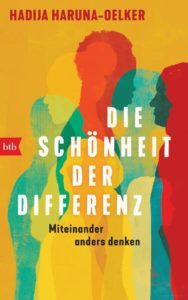
So it happened that during a trip to the other side of the island, Hadija Haruna-Oelkers„ book “Die Schönheit der Differenz – Miteinander anders denken" (The Beauty of Difference – Thinking Differently Together) was recommended to me. Andreas and Ines told me about the book, which had been so instructive for them that I was already looking forward to going home to read it myself.
Indeed: as white As an academic, feminist and activist for equality and self-determination, I found the book instructive, profound and comprehensive. The intersectional perspective provided me with insights that touched me deeply.
Insights into the perspectives of intersectionality
Hadija Haruna-Oelker is a political scientist, journalist and presenter, and her 560-page work provides a comprehensive insight into the perspectives of intersectionality and discrimination. Interwoven with her own biography, she takes readers on a socio-political journey of reflection. She tells stories about connections, empowerment and solidarity, as well as exclusion, pain and changes in perspective. She herself says, „I put my heart into it and wrote down my thoughts of the past years in our society and my history“ (Twitter on 14 March 2022).
In nine chapters, Haruna-Oelker explains what you need to know about the intertwining of various forms of discrimination and how they reinforce each other.
- Socialisation: How do we become who we are?
- Movement: What influences us?
- Globalisation: How do we live?
- Construction: What will become of us?
- Emotion: How do we feel?
- Classification: How are we categorised?
- Gender, sexuality and the body: how do we view ourselves?
- Mind: How do we perceive?
- Disability. What are we ignoring?
are the chapter headings, and Haruna-Oelker begins each one with a quotation. Ingeborg Bachmann, May Ayim, the Talmud, Michel de Montaigne and many others are quoted, and further quotations are added to the headline questions as an introduction.
In the chapter on exercise, for example, it says:
„Movement is physical work. It is created by contracting or tensing muscles. In the social sciences, it is a collective actor. Political movement stands for the organised pursuit of political goals, because people want to make their living conditions, their desires and needs tangible and assert them. A force and current to change social conditions. Equal rights for all. Where do I stand?“
Activism and science
Haruna-Oelker repeatedly refers to companions; it is noticeable how connected she is to a community, a discourse, and it becomes clear how she wants to make her voice, her experiences and her writing skills available.
I think she does a really good job of engaging her readers: written in a careful and easy-to-understand style, she explains the connections between the various forms of discrimination, giving scientists and activists alike a voice. This combination makes everything she writes very easy to understand. I found the recurring references to her own biography particularly instructive.
Reading the book was like a journey through different worlds for me, and it makes it clear how these worlds are interconnected in their own complexity and should no longer be viewed independently of one another.
The subtitle, „Thinking differently together,“ lives up to its promise, as Haruna-Oelker celebrates different perspectives and invites us to engage constructively with heterogeneity.
Reading that encourages reflection
Following Tupoka Ogette's „Exit Racism“ and Alice Hasters’ „What White People Don't Want to Hear About Racism, But Should Know“ as well as many other publications on issues of inclusion (e.g. Boban/Hinz, Index for Inclusion), diversity (e.g. Gümüsay, Language and Being) and discrimination (Criado-Perez, Invisible Women), Haruna-Oelkers' book is an enriching follow-up for anyone who not only wants to confront their own everyday racism (to which others are inevitably exposed), but also wants to raise awareness of other social injustices and discrimination.
The book also offers many ideas for organisations that actively seek to raise awareness of discrimination, encouraging them to recognise the beauty of difference by thinking differently together.
The Beauty of Difference – Thinking Differently Together by Hadija Haruna-Oelker (2022)
 Deutsch
  English (UK)