
Contained spaces & facilitation (1/2)
Contained spaces & facilitation (1/2)
How are settings for creative openness and transformation created?
How are settings for creative openness and transformation created?
Author: Simon Mohn

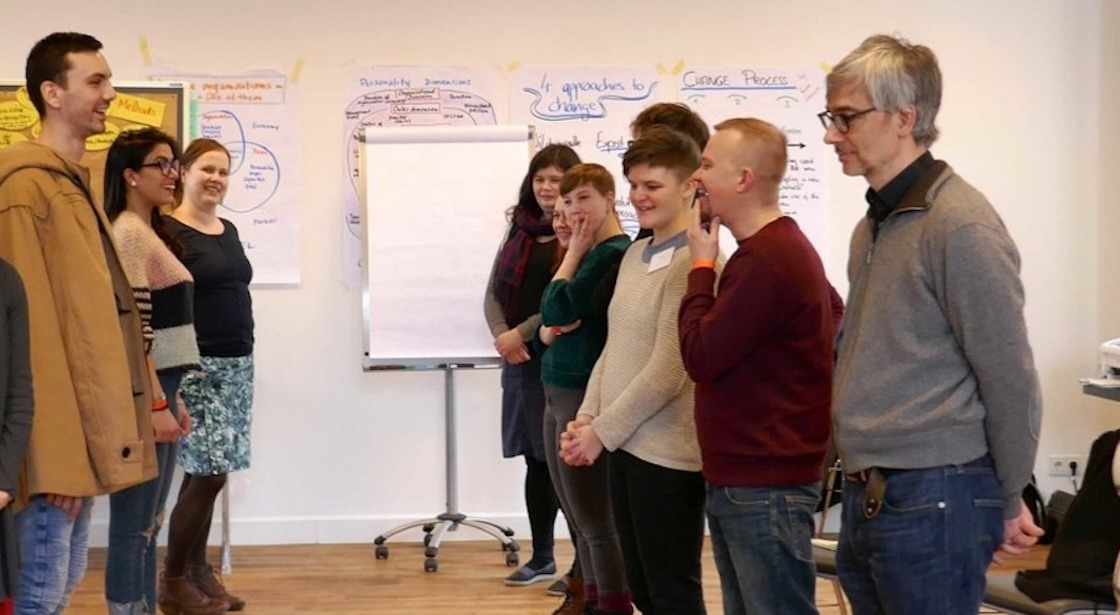
The concept of „held spaces“ is well established in the facilitation of group processes and is becoming increasingly important in the development processes of organisations. A held space is difficult to define; it is characterised by an invisible quality, imaginable as a socially constructed bubble that can open up opportunities for development and change and make them accessible. The understanding of what constitutes a held space is as broad as the diversity of its manifestations, which vary according to purpose: the space for a creative process in a team may differ greatly from that for conflict resolution, and the space for joint learning processes feels completely different again.
Our aim is to clarify what these variations have in common, which specific features are important for different „spatial purposes“ and how opening and maintaining spaces can be communicated and learned in an organisational context. We approach the topic by piecing together our experiences, without claiming to provide an exhaustive analysis.
Held space – what are we talking about?
The special quality of held spaces can be illustrated by the setting for personal development in the group process.
Personal development workshops require a trusting atmosphere in which participants feel secure enough to allow themselves to be vulnerable. In such a space, it is acceptable to show the full range of human emotions, including socially condemned emotions such as envy, resentment, grief, neediness, playfulness, silliness, etc., without fear of sanctions. At the same time, this does not mean that any form of expression is acceptable; facilitators must ensure that everyone treats each other with respect. Maintaining such safe spaces requires a great deal of skill, presence and maturity on the part of the workshop leaders.
Preserved spaces – essential qualities
What characterises these spaces – whether in workshops, organisations or other gatherings? We have compiled a few aspects that we would like to present as an initial proposal.
- A held space has implicitly or explicitly change As an agenda: the people and/or issues being addressed leave the room transformed; they are no longer the same as when they entered, whether this involves a different self-perception, changed thought patterns or new relationship qualities. The nature of the change that actually takes place can be influenced but not controlled. Entry into the room must always be voluntary.
- A private space invites people to reveal more about themselves than they would in any kind of public setting. A well-maintained space ensures a higher degree of trust, so that people in the room can step outside their comfort zone, feel confident enough to try new things, and integrate these experiences in a way that broadens their repertoire of thoughts, experiences and/or behaviours. This requires a certain amount of time – trust develops over time and cannot be taken for granted.
- A held space is also a resonating body, The elements within it (people, topics, objects – the latter could be configurable carriers of meaning such as canvases, maps, plans, etc.) can resonate with each other, revealing how they relate to and interact with one another. Unlike in everyday life, resonances are condensed here, creating a feedback dynamic that drives the above-mentioned change. This offers the people in the room expanded perspectives and new experiences.
- After all, a held space is a framework in which a testimony of what is happening. Whatever happens, whatever risks are taken, whatever developments and discoveries are made, they are mindfully observed by the participants and, on behalf of the group, by the facilitator. This seeing and being seen gives the process and its results a deeper meaning and enables the emergence of collective truth.
Open up the space
The decisive quality of preserved spaces arises initially from the fact that a space is deliberately opened up. Spaces can be designed in very different ways, so the various aspects of opening up have different weights. We consider the following aspects to be important for opening up:
- First, a room must be identified as such. It needs defined contours. On the one hand, this means a social membrane that distinguishes it from the public situation (as a temporary, exclusive container), and at the same time a clear beginning and a defined end – usually set in terms of time, possibly also dependent on goals or other factors. Often, a certain degree of internal structuring is necessary (in terms of time and content) and a good balance between flexibility and adherence to these structures.
- Secondly, the special quality of the room must be made clear. Anyone entering the room should be aware that others Rules of coexistence are considered normal and what these are. The rules can be set or developed jointly by those entering. This includes an agreement on which aspects of what happens in the room may not be disclosed to the outside world and which may. It is also helpful to agree that all human emotions are allowed and accepted as they are. It is essential to add that this does not mean that any behaviour is permitted. Feeling anger does not justify unrestrained and hurtful „venting“. It must be ensured that showing oneself is not punished. This must also be guaranteed after the open space has ended, otherwise trust will be lost next time.
- A confined space inevitably gives rise to the unexpected, keyword: emergence. That is why the architecture of the space needs to respond to the Dealing with the unexpected and unpredictability. Especially in the beginning, more structure and conscious space opening is usually needed, whereas later on, creative handling becomes possible. In recurring spaces or even within a single space, rituals are a helpful element for marking transitions and providing security through repetition.
In second part of this article It is about the qualities of those who create and maintain such spaces and invite people to change. We also ask what challenges the concept poses when applied in organisations.
 Deutsch
  English (UK)