


Construction noise was coming from the floor above us into the SOCIUS seminar room. Christian found this very annoying for the check-in round. And it immediately became clear how things would work here today: “Christian, that's not construction noise, that's the fart sound system we installed a few weeks ago in preparation for the lab! Be glad we haven't got that far with the odours yet!” explained Hannah Hummel and the whole group laughed. The noise from the first floor was no longer disturbing.
The seven muscles of self-organisation were joined that afternoon by an eighth muscle: the Lightness muscle. And the small group made the most of the four hours with Hannah Hummel and Lea Fandrey from Leipzig had some serious fun on the training course they had brought with them.
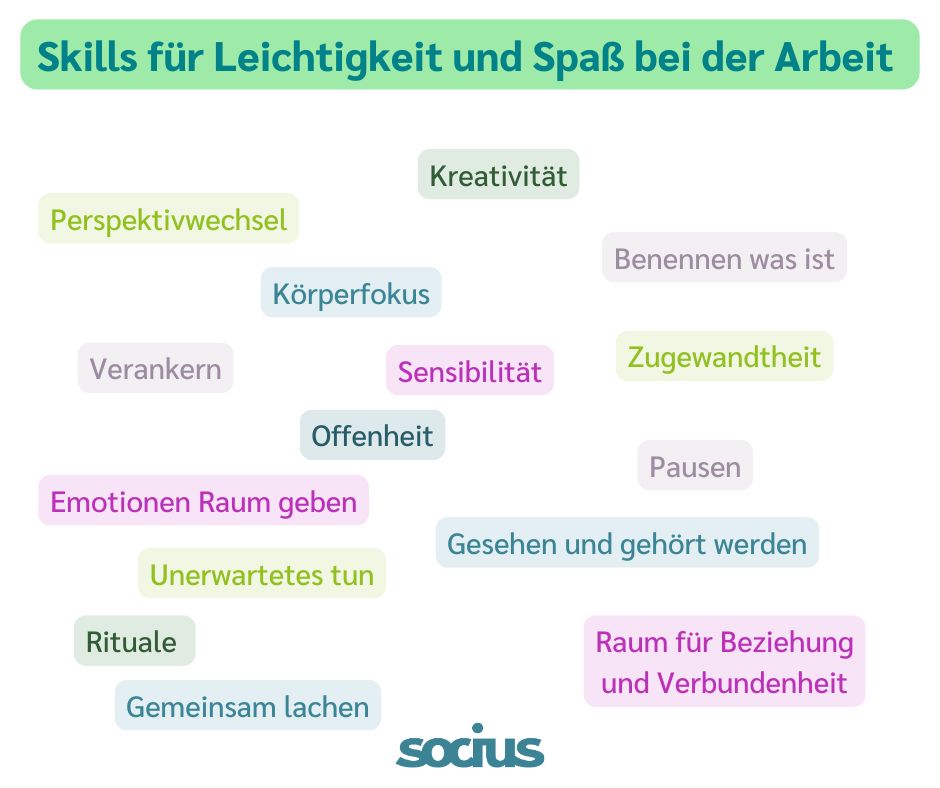
There was a writing exercise, some personal revelations on beliefs about fun, an arhythmic dance competition, an input on the twisted iceberg, a collection of tools and skills that bring lightness to life, forum theatre and last but not least the manifesto for more lightness.
Fun has a bad reputation
Following the conscious writing on the small question: “Why are you here?”, the participants were given the task of writing down one thought, one sentence on the topic of fun and lightness in each of the four categories: social culture, organisational/work culture, personal beliefs, attitudes and convictions - preferably the one that comes to mind first.
The other participants then positioned themselves on the respective thoughts. At least that was the idea. It quickly became clear that we would like to engage in dialogue and discourse, but that we only implemented the physical positions on the statements in exceptional cases.
We discovered that there are very different organisational cultures. Those in which phrases such as “We don't have time or money for fun and ease” and “If work is fun, it's not work and we can't get paid for it” are just as familiar as those in which attitudes such as “We work and have fun doing it” and “#Sfun at work is essential for productivity and effectiveness. Interpersonal relationships are part of it, great emotions do not fundamentally exclude objectivity” exists. The range of experience was therefore broad.
On a societal level, we have found a lot of collective beliefs about fun and lightness that we have all heard before:
- “Humour is when you laugh anyway.” - What does that actually mean?
- “ If you can party, you can also work.”
- “Fun and work have nothing to do with each other.”
- „Effort pays off.”
- “Laughter connects.”
- “Humour can be a weapon.”
- “We're not here for pleasure.”
The image of work that we have found here on a social level has also been reflected in the personal beliefs that prevent us from having fun at work: “Silliness is unprofessional”, “Behind all the fun there is also a serious side”, “When I am serious, I am also taken seriously„, “What goes around comes around”, “You have to sit down for team meetings” [it's not called a team meeting for nothing].
This was in stark contrast to the (developed) convictions and attitudes:
- “Work without fun and ease is unprofessional.”
- “Work can/should/can be fun and enriching. There need be no fear of effort.”
- “Humour can be liberating.”
- “Humour can be healing.”
- “Basically, it's always about presence and contact.”
If we apply the Pareto principle to the relationship between fun and work, we agreed that 80% of work should be fun, so that the remaining 20% can be done.
Cheerfully on
After a break, we got back to work with a dance exercise - dancing rhythmically was a challenge that was great fun for everyone and led to lots of laughs. Give it a try in your team if you need a bit of lightness!
Hannah and Lea then took us into their reflections on the possibilities of measurement: How can we determine that we are exercising our lightness muscle? Where are we - individually and as a group - on the continuum of lightness and heaviness? Especially when we know that we are so much better trained in heaviness and also perceive it much more directly.
Recognising somatic reactions is a wonderful key. When things get or are difficult, our breathing becomes shallower, our shoulders tense up, we stop moving, we can no longer think freely, our stomach tightens, we have a stone in our stomach, sometimes we stop breathing altogether and hold our breath, we get nervous and “go into our heads”.
And what can provide relief when the famous pink elephant is standing in the room and nobody is addressing it?
Enquiries - “Do you notice that too? This heaviness right now?”: If your colleagues feel it too, you can change something together. If you're the only one feeling it, it's probably an indication that you've found a personal issue that needs to be looked at and worked on.
We feel lightness when we can breathe deeply, our body is relaxed, we are bubbling with joy, we giggle with excitement or inspiration, we have a smile on our lips, we have an overview of the current situation, we get into the flow together.
The twisted iceberg
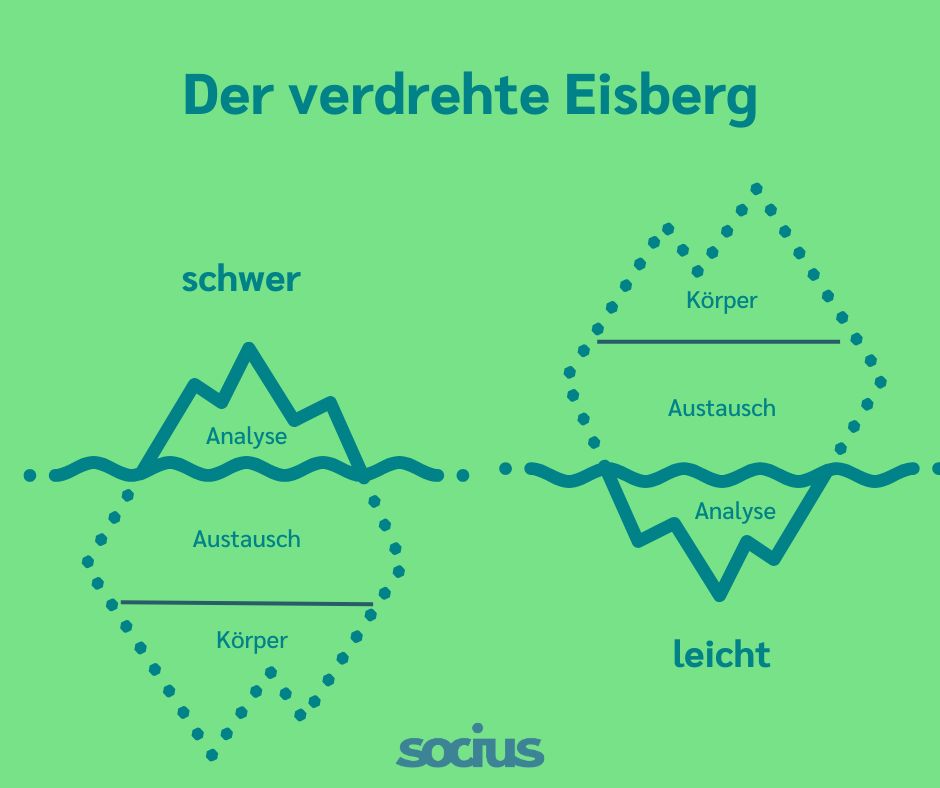
We all found Hannah and Lea's idea of turning the well-known iceberg upside down and allowing the somatic reactions to protrude verbally far out of the water and the analysis of the situation to disappear below the surface so interesting that a lively discussion ensued about what else could be considered and changed here.
On the stage
We use the last hour in the SOCIUS lab to work in two small groups. Forum theatre to play. Two scenes were put on stage, each with team situations that were difficult and in which people were not able to get in touch with each other well. Hannah and Lea had prepared a “toolbox for lightness” and the task was that each person on stage was given a tool and the scene was then played again using these tools.
It was quite astonishing how much small interventions can change the situation, and also how each individual can contribute if the known skills and tools are used consciously.
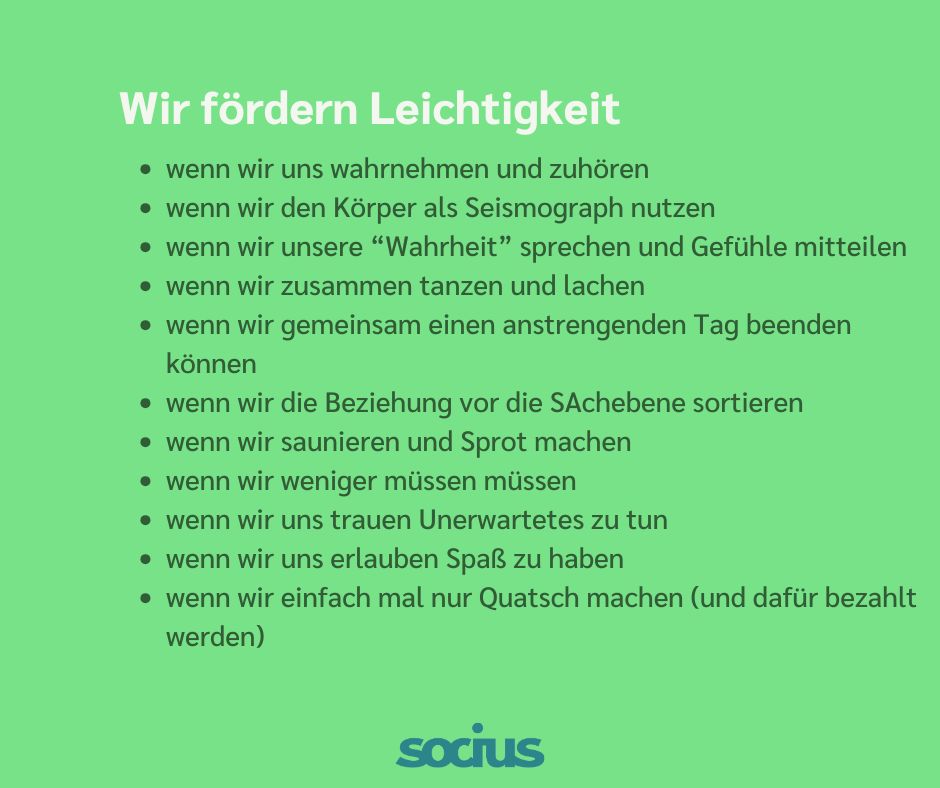
Finally, we write the “Manifesto for more lightness” - in two parts.
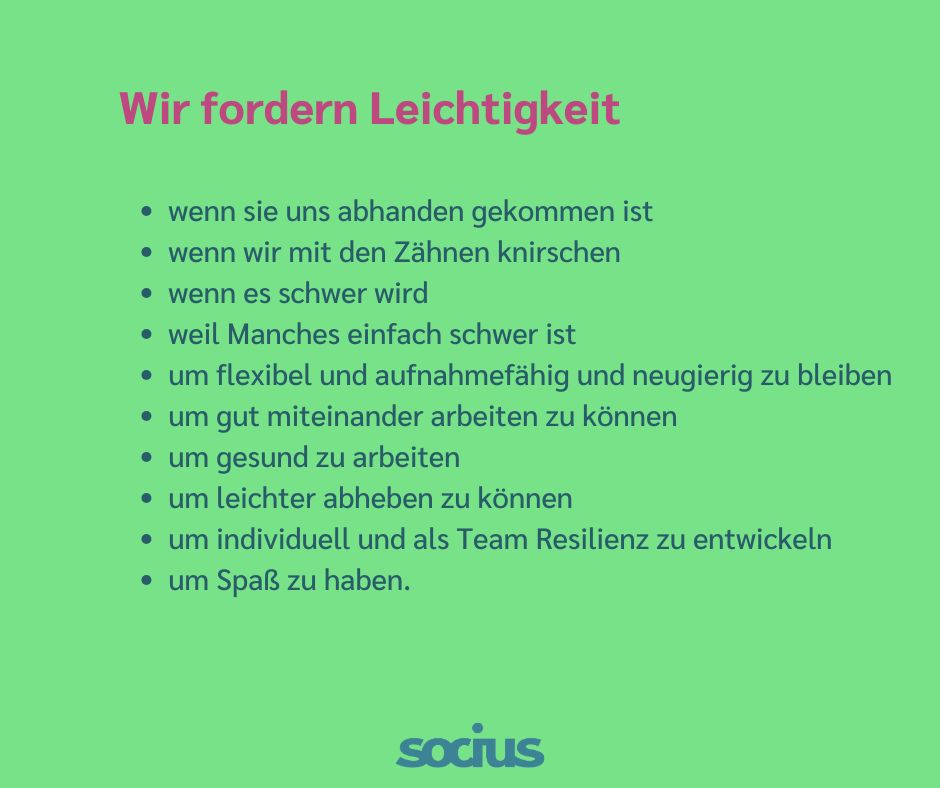
After the lab, we sat together for over an hour in the SOCIUS lounge and talked about this SOCIUS lab before everyone went home feeling light and exhilarated.
 Deutsch
  English (UK)