

 How it all began
 How it all began
The question with which Kerstin Gollembiewski the impulse for the first SOCIUS laboratory at the Hamburg life jacket factory was as open as it was inspiring:
How do we nurture a firm belief in organisations that „something completely different is possible!“?
In times of minor and major crises, in moments when we long for security and guidance and lack connection with colleagues, change often seems exhausting – sometimes even threatening.
And yet: new challenges require new ways of thinking. Organisations need spaces where people can dream, hesitate, practise and experiment in a playful manner.
So how do we create more of it?
A first spark
One possible answer became apparent right at the start – in a sentence that lingered quietly and clearly. When asked about her motivation, one participant said:
„I don't really know exactly what this is all about anymore. But I do know that I long for exchange, connection and inspiration. And I am firmly convinced that I can find that here today.“
 Together, we invited for the next four hours Longing and curiosity, Security, openness and slowness as accompanying qualities.
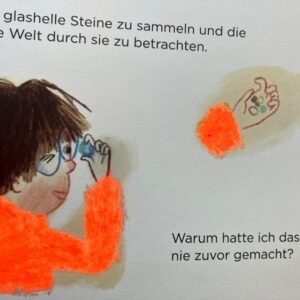
An excerpt from Beatrice Alemagna History „A big day on which almost nothing happened“ became a delicate yet powerful frame:
A child loses his gaming computer in a frog pond, despairs at the thought that nothing exciting can happen now, and then spends a surprisingly exciting time with everything nature has to offer: „Why had I never done this before?“
Expanding spaces – questions instead of answers
Early in the evening, one participant said:
„I have just realised that the change of perspective I was seeking here outside actually begins within myself.“
A sentence that opened up many possibilities.
Then things got serious – and playful at the same time: in pairs, we highlighted some of the apparent impossibilities in our organisational and working realities and immediately questioned them – for example, is it really true that failure is not an option? Is it really true that I always have to find an immediate solution to every problem? – to share just two of the very pointed questions.
With the „mischievous questions“ (wicked questions) from the repertoire of the liberating structures we got to the bottom of the apparent impossibilities in our working environments.
Our goal was not to find answers, but to expand the space. To question the seemingly impossible – and discover the glimmer of possibility within it.
Invite emergence. And it came.
From questioning to designing
 From questioning to designing
In several rounds of „wicked questions,“ we asked each other questions big and small, serious and playful. Nods, frowns, sparkling eyes – each face told its own story.
Then we expressed what we had experienced:
What feelings, colours and movements do you perceive within yourself? What essence is revealed in the questions?
With feathers, photographs, paint and imagination, images of a future where „something completely different is possible“ were created.
And after that?
„Perseverance and effort in processes now feel easier. I am permitted to explore other avenues – other (inner) landscapes have emerged.“
Together, we left the laboratory and went into the rest of the evening with (more) courage to be and act „differently“, with gratitude for the encounter and exchange, and with the affirmation „I am allowed to irritate“.
And we, Kerstin and Hannah, are already looking forward to the continuation on 14th of November – to which new interested parties are of course also warmly invited.

 Deutsch
  English (UK)