


 Several years ago, the SOCIUS team had experience with two grieving colleagues who had to let go of loved ones within a very short period of time. The team, which at the time consisted of eight people, reacted intuitively: with empathy, understanding and patience. Previous bereavements in the lives of the team members had involved elderly parents. This time, it was suddenly different, involving siblings and friends. That made a difference.
Since then, the topic of „grief in the workplace“ has been on my mind a lot. And not just there, but also elsewhere in our society. I often encounter speechlessness, hesitation, restraint... as if silence alleviates the pain.
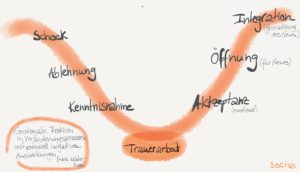
At the same time, in our work as change facilitators, we often refer to grief processes as described by Elisabeth Kübeler-Ross in her grief curve. This is because the phases of emotional processing can be similar in some respects.
I met Franziska Offermann during the Bohana-network, which brings together people who deal with the topics of grief, death and funerals in their professional lives and serves as a platform for people who are looking for support, want to find out more or are trying to „be prepared“ themselves.
Franziska published her book back in 2016, and it begins with her very personal story: how the death of a child changed her life forever. She recounts how she – a pharmacist with a doctorate – experienced how everything changed in her working life after this event and how it became increasingly clear to her that she needed to pursue new career paths. She was intensively involved in the Bundesverband Verwaister Eltern e.V. (Federal Association of Bereaved Parents) for a long time and then founded her own company. Lucera – Integrating grief into the system.
In her book, Franziska Offermann leads readers, after a very personal introduction, into a world of thoughts and actions that leaders, colleagues, consultants and teachers should be aware of: that people die, that it is part of life and can happen at any time. It is good to face up to this issue.
The nearly 200 pages plus informative appendix are divided into seven chapters aimed at mourners, colleagues and leaders, transforming the principle of „CONDOLENCE“ into an acronym that can describe an entire process:
B Shape relationships, ask about needs
E Empathetic communication, taking all feelings seriously
I Individuality: everyone is different! Gather information!
L Logistics of the organisation and structure
E relaxation, relief
I Express interest, integration of what has happened
D Keep going, stay tuned
Franziska shares her insights on grief and the possibility of grief counselling in the workplace – what opportunities does this offer for health and team building or bonding?.
How can bereaved individuals continue to work without having to pretend that their grief does not exist, yet without being reduced to it? Here, the author takes an in-depth look at the different stages of grief. The last third of the book offers concrete advice for colleagues, including how to offer appropriate condolences, how rituals can create trust and security (not only for those who are grieving), and how embodiment can be used in the workplace to reach the soul through the body.
Because work contexts today (can) mean so much more than just earning a living in a performance-oriented society, organisations and employees increasingly expect to be able to show themselves as whole persons and no longer be reduced to the professional layer of their being. Against this backdrop, Franziska Offermann's book is an important contribution for all those who welcome all aspects of life into their organisations and do not shy away from contact with people who have had painful experiences.
For me, the book is a real asset. It gives me guidance and suggestions for my work, and Franziska never loses her attentive, caring tone. Thank you for that, Franziska. Looking back on my experience in our team in 2013/14, I can say that we worked together intuitively and effectively at that time. Today, in August 2021, we unfortunately have the task of doing this again and keeping a grieving colleague in our midst.
 Deutsch
  English (UK)