

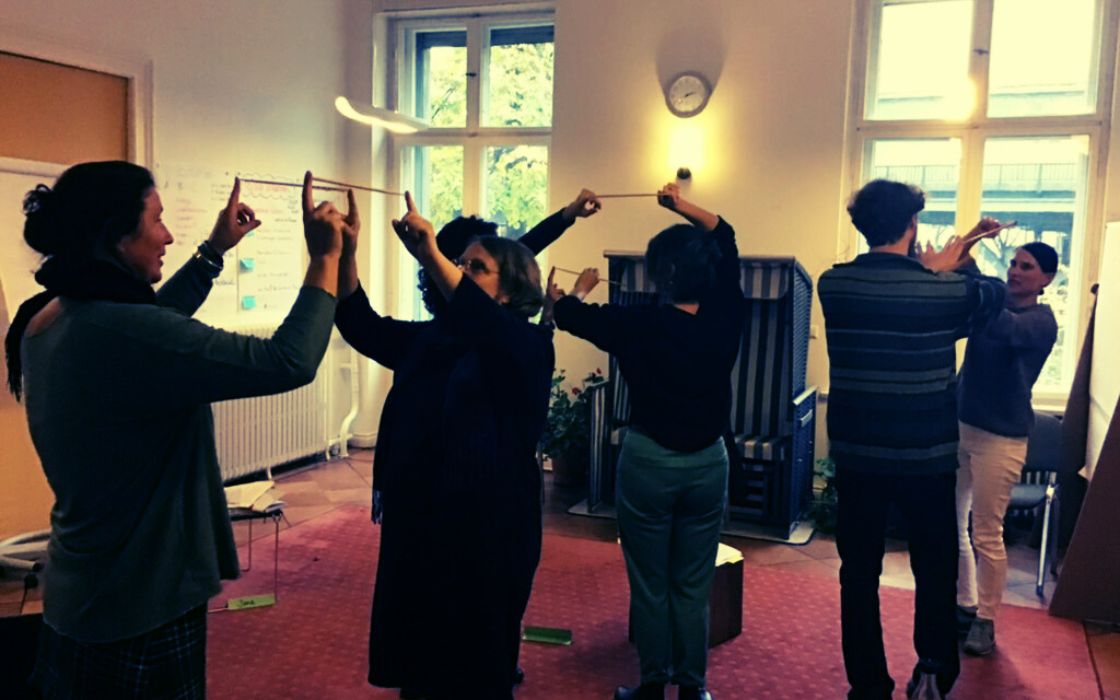
The SOCIUS lab with Hannah Hummel in autumn 2019 was an intensive laboratory with six participants, which made the improvisations a very personal experience. Hannah Hummel is a social pedagogue and has been performing improvisational theatre for over 20 years. Her work and her passion can be combined well, as improvisation is also a helpful skill when working with children and young people.
In the lab, Hannah Hummel took us into the world of improvisational theatre. It's not for nothing that improvisation theatre is sometimes called theatre sport. In addition to physical exertion, mental training was also part of our work as we followed the five basic rules of improv theatre:
- Accept positively what is offered
- Rescue colleagues when they don't know what to do and trust that this is exactly what will happen
- failing cheerfully - error-friendliness and acceptance
- Be mindful of the relationship and act with a clear role
- Be present in the situation and act together
 It is already clear here how much improv theatre, working in teams and New Work have in common. In the agile design of our working world, we can be more than just inspired by the practice and insights of improv theatre. We can use improvisation, for example, to move from the meticulous planning of the pre-VUCA world to a contemporary form of planning in which sense-and-respond, i.e. more conscious perception and more spontaneous reactions, are promising approaches.
In our work contexts, we often call what is called play in improv theatre „practice“, out of the conviction that work is not play after all, but that we need practice in order to be able to work even better (together). Once again, it became clear how much the recognition of what we do depends on the context in which we do it.
Nothing goes according to plan, but nothing works without a plan
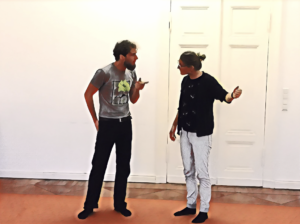 Hannah Hummel's work illustrated the interplay between planned and intuitive behaviour. On the one hand, she was very well prepared and followed an (inner) plan. She brought experiments with her that we would work on in the lab. At the same time, she improvised with those who were there in front of the white screen, so to speak, and trusted her intuition, which was fed by experience, by following the principles mentioned above as the laboratory director.
In the systemic world of thought, Luhmann's concept of contingency would be invoked here: that something is neither necessary nor impossible. In short: everything could be different.
In addition to all the practice in being present, saying yes and using their own bodies as an instrument, the lab participants also learned about influential improv theatre makers. First and foremost Augusto Boal, who developed a „method of social change“ recognised by UNESCO with his Theatre of the Oppressed. Hannah also told us something about Viola Spolin and Keith Johnstone, who particularly impressed her. However, we participants were in such a playful mood that we wanted to play even more.
The four hours of „improv training“ flew by and we had an enjoyable, insightful afternoon with hearty laughs and great amazement at the hidden talents that lie within us.
The excellent soup in the lounge afterwards gave us strength, and we stayed around the open fire for quite some time, enjoying the exchange and reflecting on what we had experienced.
For me personally, what remains is the memory of a realisation that I always wanted to put into a blog with my colleague Ralph Piotrowski: Allet eens!
In other words: all the different approaches, philosophies, methods and tools that we would so like to clearly separate from one another serve the same goal with a similar attitude: meaningful interaction!
 Deutsch
  English (UK)