


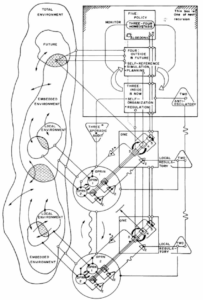
 My first encounter with the Viable System Model (VSM) came about while searching for the most cryptic diagram possible for a Power Point Karaoke. What Stafford Beer The music that the musician who put down on paper at the end of the 1970s is, at first glance, a fascinating imposition: very suitable for karaoke, but definitely too bulky for shirt-sleeved OE practice.
The VSM is experiencing an astonishing renaissance in the current complexity discourse. It opens up a view of the often overlooked „third dimension of organising“ (Pfiffner 2024): In addition to the classic organisational structure (Anatomy) and the process-oriented workflow organisation (Physiology), the focus here is on the control and communication systems - the „Neurology of the organisation“.
From complexity monster to practical tool
Mark Lambertz's achievement in ’Intelligent Organisation„ is to present Beer's theoretical plank in such a way that the reader does not suffer an overdose of abstraction. He uses tangible example is the German national football team, to explain the five subsystems of control that every organisation needs to be viable (viable):
- System 1 (Operation): The place of value creation, the actual „doing“ that creates the impact (in football: goalkeeper, defence, midfield/forward).
- System 2 (coordination): Support and location of the self-organisation of the first system. The instance that keeps value creation going and prevents the units of system 1 from „stealing each other's moulds“ (assistant coaches, team doctors, caterers, etc.)
- System 3 (operational management): Tactical Management, which continuously organises the optimisation of the interior. Incl: System 3*, which analyses fluctuations in sporadic audits. (Coach and team manager)
- System 4 (future/strategy): The strategic management, the periscope that keeps the view and the voice outside. (National coaches, scouts and staffs)
- System 5 (identity/framework): Normative management. The compass that shapes the „why“ (purpose and vision) of the organisation and marks out the playing field. (DFB committees and team council)
- Environment (market & stakeholders)The mosaic of business and social stakeholders and environmental developments (associations, sponsors, fans, opponents)
The allocation to the systems is not free of overlaps. Unlike an organisation chart, it is not a question of clearly locating individual actors in one place in the model - the five systems are more like arenas in & between which information and perspectives on management are wired. The model can be applied to any detailed level of the system (the entire organisation, a department or even just a team).
The law of experorderual diversity
The Viable Systems Model is rooted in the realisation of Ashby's Law: „Only variety can absorb variety.“ An effective solution system must therefore have at least the same complexity (variety) as the problem or the environment that it wants to solve (perhaps this also explains why I find the fine-grained logic of the VSM to be so complex in these cases). crazy times suddenly seems somehow obvious after all).
The central message is relatively simple: Lambertz exposes the widespread „theatre of control“ in his remarks. He points out: Intelligence in a modern organisation does not mean that clever minds steer lonely from the command bridge. True organisational intelligence is created through networking that allows the system to continuously learn and steer itself.
Peter Kruse also realised this in his Leadership Talks to the point:
„We have a centuries-old tradition of preventing networking. The promotion of networking is the letting go of this prevention. (...) If we do not manage to create the freedom of complex networks in a highly complex networked world, we will unfortunately no longer find the solutions we need“.
It is up to the reader to decide for themselves how the management principles and axioms of the VSM, which Lambertz patiently explains in simple language in the second part of the book, guide action based on this realisation. In any case, the formats with which the model can be used as an analysis and design framework in OE practice and the case studies from companies and organisations that illustrate this application are helpful. Lambertz's many years of consulting experience in the field of digital strategies and agile organisational models come into their own here. The book concludes with a few ‘brain teasers„ on the design of system elements and the general handling of complexity in organisations. All good.
Conclusion
The Viable Systems Model is not a „paint-by-numbers“ approach. Rather, it is a new pair of glasses. Anyone who puts them on suddenly sees the missing feedback loops, the blocked channels and the unutilised potential of control everywhere. „The Intelligent Organisation“ offers a low-threshold and entertaining introduction for all those who want to design the neurology of organisations in a complexity-oriented way.
Mark Lambertz
The intelligent organisation - a playbook for organisational complexity
5th edition 2026, BusinessVillage Verlag
ISBN: 9783869804095

 Deutsch
  English (UK)