


We have eliminated nothing other than blind, irrational authoritarian behaviour, which has a negative impact on productivity.
With this quote, Ricardo Semler describes what motivated his mechanical engineering company SEMCO to break new ground over 50 years ago. Since then, the „technology of sociocracy“ has been further developed in numerous in-house experiments – including in this SOCIUS laboratory.
Vivian Breucker (Offene Schule Köln) and Nicola Kriesel (SOCIUS Organisationsberatung) invited us to a four-hour workshop in which we, together with 20 other people, immersed ourselves in sociocratic principles and shared practical experiences.
After a brief introduction to the second and third sociocratic principles (semi-autonomous circles and double linkage), the session continued with a practical discussion in which Vivian Breucker shared her experiences of sociocratic practices at the Offene Schule Köln (Open School Cologne). The Open School Cologne is a recognised independent school that gives pupils from the first to the thirteenth school year the opportunity to prepare for various school-leaving qualifications largely independently within the framework of the curriculum. Inclusion and diversity sensitivity play just as important a role here as personal initiative and educational equity in relation to individual needs.
Semi-autonomous circles
- Each circle is a semi-autonomous unit to which part of the responsibility and work is delegated in order to achieve the common goal.
- In addition to shared organisational goals, circles also have their own goals/purpose and a definition of where autonomy ends (interfaces/synergies).
- Circle members are jointly responsible for achieving the goal and implementing the tasks.
- Decisions are also made by consensus in the circles.
- Circle members are not only sought after for their professional expertise, but also learn to take on organisational responsibility.
- In order to “produce organisation”, it is useful to learn, for example, how to justify serious objections with arguments (focused on the goal). Familiarity with the KonsenT decision-making process is important.
- Repeated review of decisions: lead, act, measure and, if necessary, change. This is recorded in the decision logbook.
Double link
- Basic idea: In order to maintain the connection to the next higher circle, two people from each circle participate in the decision-making process of the next higher circle.
- An organisation usually needs several circles in order to reflect its complexity and to share responsibility and work.
- At the same time, ways are needed to “transfer” the dynamics of the individual circles to the others.
- There is talk of “higher circles” with which this connection (double link) is supposed to exist.
- These individuals are
- the person in charge
- a delegated (elected) person
- This is to ensure that the dynamic process is not interrupted, but that information, tension and power can flow.

To the inspiring insights gained from practical experience, include insights such as:
- The quality of the „sociocratic listening“ leads to more sustainable decisions because not only the formal results, but also concerns and perspectives expressed in one circle are taken up by the delegates in the next higher circle.
- At the Introduction of sociocratic practices the traditional leadership of the organisation must be on board – otherwise sociocracy has no chance. Interestingly, this applies in particular to non-hierarchical organisations, where there are always people who have more power and influence than others.
- Yourself not blindly adhere to sociocratic guidelines, but allow for a mix of sociocratic circle discussions and other discussion formats. Formal sociocratic circle decisions and consensus, e.g. only when it comes to forward-looking, essential decisions that need to be firmly anchored.
- When making decisions, always keep the following question in mind: „Is it good enough for now? And safe enough to try?“Keep in mind that answers should be found in order to take the next step. Not answers that have to be valid for 10 years.
- The format of the decision-making rounds requires practice, and crisp, firm formatting is helpful here:
- Information session (1-2 times)
- Opinion round (2-3 times)
- proposal
- objection round
- modification
- round of consultations
- clarityClearly define which meetings are mandatory for whom and which meetings are voluntary. For example, distinguish between self-organised working groups (which set their own rules of engagement) and management groups (in which persons with management responsibilities are required to participate). Good visualisations of decision-making structures are very helpful, such as the following overview from Offene Schule Köln:
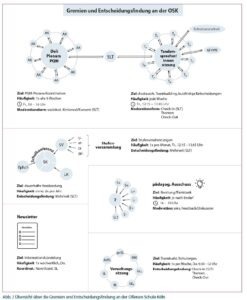
In addition to practical tips, the lab also provided space for self-awareness. Among other things, the question arose: “How many people can I listen to in a circle facilitation? What is my upper limit before I start to drift off mentally?” The answer to this question may also depend on what I believe myself and my colleagues in the circle are capable of. And that, in turn, led to the insight that circle discussions offer a shared learning space in which we can practise making rounds with 30 people just as energising as those with seven.
Feedback from the final round of the laboratory included:
- I learned a lot, especially experiencing how great it is to speak one after the other in a circle, which made it clear that everyone is holding the space.
- What I am leaving behind: my idea that self-organisation makes leadership superfluous.
- The fact that sceptics are explicitly welcome in the circles because they point out something that has been overlooked is a mind shift.
- Time and again: experiencing the power of the circle first-hand is so enriching and also relaxing. This allows new things to emerge.
Overall, after four hours of SOCIUS labour, the mood was inspired and hopeful, and not only the participants were keen for more sociocracy, but also the hosts.
Stay tuned!
Resources
- SOCIUS and OSK slides on download
- Review: Ricardo Semler: The Semco System – Management without managers – The new revolutionary leadership model. Heyne Business, 1993: A worthwhile read about the roots of sociocracy – experiences at Brazilian engineering company Semco.
- Playful decision-making exercise game
- SOCIUS change essentials videos: consensus moderation in practice and roller board
- SOCIUS change essentials: Consent to download
- oe-tag – Forum for non-profit organisational development
- More from Vivian Breucker and the Open School Cologne
- Extensive collection on sociocracy: https://www.soziokratie.org/
- SOCIUS at the Sociocracy for all Conference October 2022: https://youtu.be/_hqGSsrl-go
 Deutsch
  English (UK)