

Self-organisation is more of a practice than a structural model. And while models can be easily adopted, the path to mastering a practice is the practice itself: studies estimate that it takes 10,000 hours to achieve excellence in a field (Malcolm Gladwell 2009: Outliers). To become an „excellent“ pianist, for example, I would have to practise the piano for three hours every day for 10 years. So how did we come to believe that all we need to master self-organisation is enthusiasm? Laloux read and change our organisational chart from boxes to circles? No, my friends, we have to train, and depending on our previous entanglements, train properly.
In one of the inspiring breakout sessions of the large Covid Networking Cloud, I had the pleasure of meeting Trine Demant from „Democracy Fitness„Together with her team, she has developed a series of short programmes that train „democracy muscles“ – personal skills that are often buried in everyday life but are crucial for actively shaping and participating in a vibrant democracy. These skills include „verbal self-confidence,“ „empathy“ and „mobilisation.“.
The workouts are energising and fun, but they're also designed to push you: „If it hurts a little, that's a good sign that you're doing the exercises correctly,“ says the introductory manual. What's amazing is that each workout only lasts 30 minutes. Hey, what about the 10,000 hours? Well, you have to start somewhere – the training is merely an introduction to an untapped part of our potential. In the words of democracy fitness: „When you're done, you'll always remember that you and others have this muscle.“.
Fascinated by this approach, I naturally wonder how it can be applied to the development of self-organisation. If we assume that we need to train ourselves to successfully pursue new ways of working together, which aspects of our abilities should we cultivate? My guess is that the muscles of self-organisation are not so far removed from the muscles of democratic fitness.
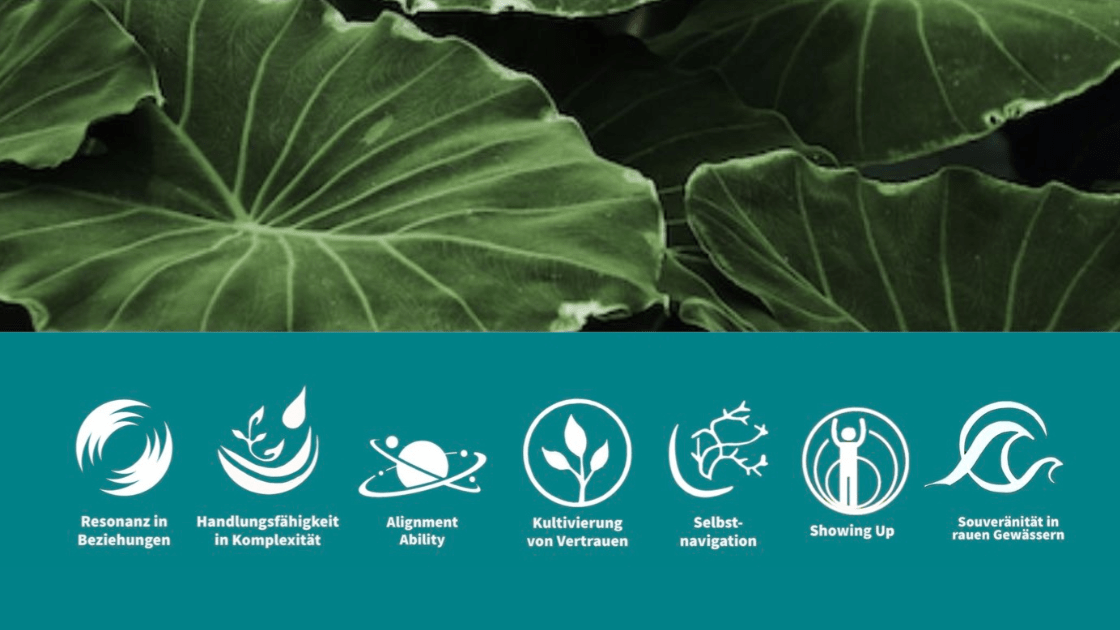
We considered this question during our last SOCIUS retreat on the Adriatic coast. The following list of the seven muscles of self-organisation is an initial outcome of these discussions:
- Cultivating trust
- Presence (in leading and following)
- self-navigation
- Confidence in rough waters
- Resonance in relationships
- Awareness for Living Systems
- Integration into the groove
Of course, there are other versions, and it certainly needs some more revision – but it's a solid starting point. Let's take a closer look at muscles, their significance in the context of self-organisation, and the possibilities for training:
Cultivating trust

(Trust the process; trust yourself and others, trust the universe, be patient, stay optimistic)
One of the most persistent reservations about self-organisation practices is that they are too time-consuming. „In calm waters, we can afford the luxury of decentralised control, but when the weather turns rough and there is a lot at stake, we should resort to something more streamlined and efficient.“ Let's take a closer look at this: self-organisation becomes slow, especially when there is a lack of trust. If I assume that my team members are incompetent or abuse their power and act in a way that serves their own interests rather than our common cause, I will try to control them. I will ensure that reports and decisions are made in plenary sessions and that approval loops and triple control systems are in place. All of this makes processes slow and uninspiring. If, on the other hand, I trust that my colleagues have the common cause in mind and act competently (or at least to the best of their knowledge and belief), I can settle for a manageable minimum of control and thus enable maximum dynamism. The zone of what is „safe enough to try“ grows.
Can this kind of trust be trained? A fundamental building block for this is a phenomenon that psychoanalyst Erik Erikson calls „basic trust“ – a deep and fundamental conviction that the world is a good place that nourishes me. According to Erikson's developmental theory, basic trust is ideally established in the first 1.5 years of a child's life and forms the basis for later experiences of trust and a confident and optimistic outlook on life. One aspect of this optimism is „people positivity“ – the belief that people are competent, capable and – unless socialised otherwise – willing to contribute to the common good.
Strengthening our ability to trust begins with the question: „When and how do I feel secure?“ And then more specifically: „When do I feel secure enough to dare to trust my colleagues in their roles and responsibilities?“ The more aware we are of our basic needs, the better we understand where the actions of others conflict with them, and can address this in a productive way.
In addition to its individual dimension, trust also has a social quality that is characterised by self-reinforcing feedback loops: trust generates trust; it is based on commitments that are honoured and promises that are kept. Without such commitments, there is no basis for the positive cycle of trust. And without advances of trust, there is no initial spark to set the spiral of positive experiences in motion. Both can be cultivated.
Presence (in leading and following): Showing Up

(Follow your instincts. Sense what needs to happen. Move forward fearlessly. Lead. And: follow: recognise and support a good idea. Go along selflessly, say yes!)
Leadership is a balancing act between internal and external impulses. Awareness of our inner selves, our feelings and trust in our intuition, contrasts with our perception and interpretation of the social environment. If we lose touch with one of these two sides, if the two worlds become mixed up or if one dominates our actions, leadership becomes difficult. In self-organised teams, leadership energy is more distributed and dynamic than in traditional hierarchical organisations, but the balancing act between internal and external impulses is just as delicate. Leadership requires a confident handling of these impulses and the ability to act sensibly and fearlessly.
Like leadership, followership in the context of self-organisation is based on courageous action. It is not about following a person, but about reinforcing their impulse. The art of following does not consist of playing along with every game without objection, but rather of picking up on an impulse and working with it creatively. Derek Sievers sums it up: „We are told that we should all take the lead, but that would be extremely ineffective. The best way to get something we really care about moving is to follow courageously and show others how to do it.“.
How can we train this muscle? First, let's remember that we all have profound experience in leading and following. Playing is a fluid dance of impulsing and going along. Children are generally just as capable of spontaneously coming up with an idea and implementing it as they are of joyfully following an offer to act: „Hey, let's...“ – „Come on, let's...“ „Yes, and...“ There are a number of reasons why this innate ability to follow an impulse (or perhaps better: ourselves) is often buried in adolescence and adulthood: We spend formative years in education systems that favour impulse control over impulsivity; we spend time in more or less regulated workplaces where impulsive behaviour is met with scepticism; and we live in a social environment that glorifies leadership while simultaneously feeding fears of failure and feelings of impostor syndrome as soon as we step outside the framework of our formal roles. It is confusing, to say the least. Training the ability to act impulsively begins with connecting with our playful selves and dismantling the internalised voices and constraints that limit the impulsive process of our inner child.
self-navigation

(Be prepared to learn and unlearn; cultivate self-awareness. Make reflection a routine; know and respect your own limits.)
The path to self-organisation involves a gradual shift from external structures to internal competence and personal development as sources of stability. The muscle of self-navigation is both a prerequisite and a product of this process. It is based on knowledge of our inner landscape and requires the ability to engage with others while respecting our own boundaries. While hierarchical organisations often entail stress due to alienation and external control, the stress in the context of self-organisation often lies in finding a healthy level of commitment, as we are responsible not only for ourselves but also for the greater good.
Self-navigation cannot be learned from a textbook. Books can provide ideas and inspiration to try new things or let go of old ones, but the map is not the territory: real growth happens through reflective action. Micro-practices and reflection routines are good containers for this. Structural support for the muscle of self-navigation requires dedicating space and time to them and defending them against the greedy waves of day-to-day business.
Resonance in relationships

(Listen deeply. Cultivate empathy and curiosity. Listen with your heart.)
The importance of resonance for any social practice is obvious. It is particularly relevant for the practice of self-organisation: the adaptive quality of self-organising systems aims at ongoing adaptation to their environment. The environment includes the external field, but also the internal dynamics that the members bring to bear. The really exciting things in these two reference worlds lie invisibly below the waterline. At the collective level, resonance means sensing such hidden dynamics.
On a relationship level, resonance is closely related to empathy. Empathy is the ability to empathise with another person and experience their emotional situation. It can be cultivated, for example, by taking on another person's perspective: putting yourself in their shoes, practising exchange and feedback. Another way is deep listening, which is anchored in dialogical practice and non-violent communication, for example.
Confidence in rough waters

(Expressing differing opinions; Enjoying the productive power of tension; Negotiating decisively; Saying no when necessary)
Teams with a strong background of „people positivity“ values often cultivate a dogma of harmony: „I won't question your idea, and you won't question mine.“ Such harmony reduces the potential for collective creativity and leads to weaknesses in decision-making: ideas and contributions are simply lumped together under a broad umbrella instead of being critically examined, selected or merged. Differences in points of view and interests are covered up with a blanket of appreciation. This type of harmony is often confused with alignment: „If we don't rub each other up the wrong way, we must have a common alignment.“.
The practice of self-organisation, on the other hand, regards tensions as necessary fuel for development. Holacracy defines them as „the gap between current reality and perceived potential“. Regularly addressing tensions also helps to prevent them from escalating into manifest problems and conflicts.
Sovereignty in rough waters erfordert a fruitful measure of engagement with such tensions. Imagine you are out for a walk and find a pile of rubbish in your path. On a one-off trip, you probably won't shovel the pile away or climb over it. Depending on your mood, you might pause for a moment, surprised or annoyed, and then walk around the obstacle to reach your destination. If, on the other hand, this is a path you walk every day, it makes sense to clear the pile away to save time and energy in the long run. The same applies to conflicts and tensions: we can simply sidestep one-off minor issues and a few special dramas. Why waste energy on something that distracts us from our goal? On the other hand, we should address the tensions that repeatedly get in our way, no matter how insignificant or massive they are.
The path to sovereignty in rough waters is simple, but not easy: practise dealing with tension without letting it drive you crazy. Initiate tension in a safe social environment and stick with it without defusing it. Be critical, be angry, be rude if you have to. Practise objecting, say no. Pay attention to your feelings, your physical and mental reactions. Take notes on your daily workarounds and decide which of these detours you want to get rid of. Then just do it and see how life goes on afterwards.
Awareness of the living system / Complexity Consciousness
(Recognise patterns and observe dynamics. Be wary of simplifications. Keep an eye on the big picture. Understand how even small things can nurture purpose. Be attentive to emerging orders.)
Awareness of complexity (Complexity Awareness) is one of the meta-skills of our time. It refers to the recognition of the non-linear dynamic quality of social processes and the ability to deal with this dynamic, which in turn requires flexibility, patience and tolerance of ambiguity. The particular relevance of this skill for navigating self-organising systems has to do with their specific mix of formal and informal settings.
Let's try another analogy: when driving a car, we control a complex system based on first-order mechanics with a few self-regulating feedback loops. Of course, it takes a certain amount of training to operate the start and control devices, to know the difference between the clutch and the brake, and to know which indicators to keep an eye on. If the car breaks down, it's good to know which mechanic can help. That's pretty much it. The really tricky part is not the car, but the traffic. Navigating heavy traffic with confidence takes more than just a little training. Traffic is a complex system; it is alive and unpredictable. It consists of dynamic interferences and self-reinforcing feedback loops that can cause sudden changes. Finding your way in this environment requires experience, mindfulness and, at times, courageous action.
Organisations combine these two qualities: while structures and processes are complicated, the social interactions within them represent a complex second reality. The more we focus on informal dynamics rather than formal structures and processes, the more we need to adapt to this complex nature of the organisation. Self-organising systems are based on a high degree of emergent dynamics – in this sense, the quality of traffic is more influential in them than that of the car.
How can we develop an awareness of the living system? Engaging with complexity initially requires a special way of seeing: it thrives on the fluid alternation between concentrated observation of details and open perception of patterns. What happened yesterday and what is happening right now is relevant. However, its significance is derived primarily from the context of what happens repeatedly.
Finally, it is also helpful to maintain clarity about our models. It is practically impossible to do justice to the complexity of our social world: we need models and shortcuts in order to remain capable of acting. If we forget that we are using these cognitive aids, we confuse our simplifications with reality.
Integration into the groove / alignment ability

(Create alignment. Feel the collective dynamic and your own role in it. Synchronise. Bring swing into play.)
The last muscle is the trickiest and most comprehensive. „Groove“ is a nebulous concept that is difficult to operationalise (can algorithms groove with each other?). The first ingredient for groove is „alignment“ – a quality that can perhaps best be translated as „shared orientation“; the second is lively dynamics, or „swing“.
A vibrant alignment does not mean that everyone is swimming in the same direction or has a common goal – it is about the overall goal being in line with the goal of each individual. matches. What exactly is the difference? In some collectives, levelling prevails: everyone follows a common direction, thinks the same, feels the same – there are no individual intentions, as each individual projects his or her agenda onto the collective. In contrast, for successful self-organisation, individual agendas must be charged and dynamically aligned with the common goal (Spotify has coined the term „Aligned Autonomy“). The slight divergences between individual and collective goals and the resulting tensions are the driving force behind development. If they are not given space and are not celebrated, the system may be aligned, but it is not alive.
Developing dynamic integration into the groove is as challenging as becoming a good jazz musician. It requires a keen ear, an open mind and mastery of one's own roles; in a sense, this muscle builds on the previous ones: on the ability to trust, presence, self-navigation and all the others. And like all muscles, it grows primarily with the experience of practice.
The list shows that there are things we are capable of doing but do not practise in our everyday social lives, with the result that the relevant skills atrophy. If we rediscover these muscles, we can train them and reclaim them. Each muscle has an individual and a collective quality. I must learn to be present and follow impulses, and we as a team must learn to make the most of these impulses. I must develop practices of self-navigation, and we as a team must create spaces that support these practices. Both individual and collective qualities can be initiated through training that stimulates the corresponding muscles. SOCIUS is working on the first series of such training units.
With that in mind: stay tuned, see you at the gym!
 Deutsch
  English (UK)