
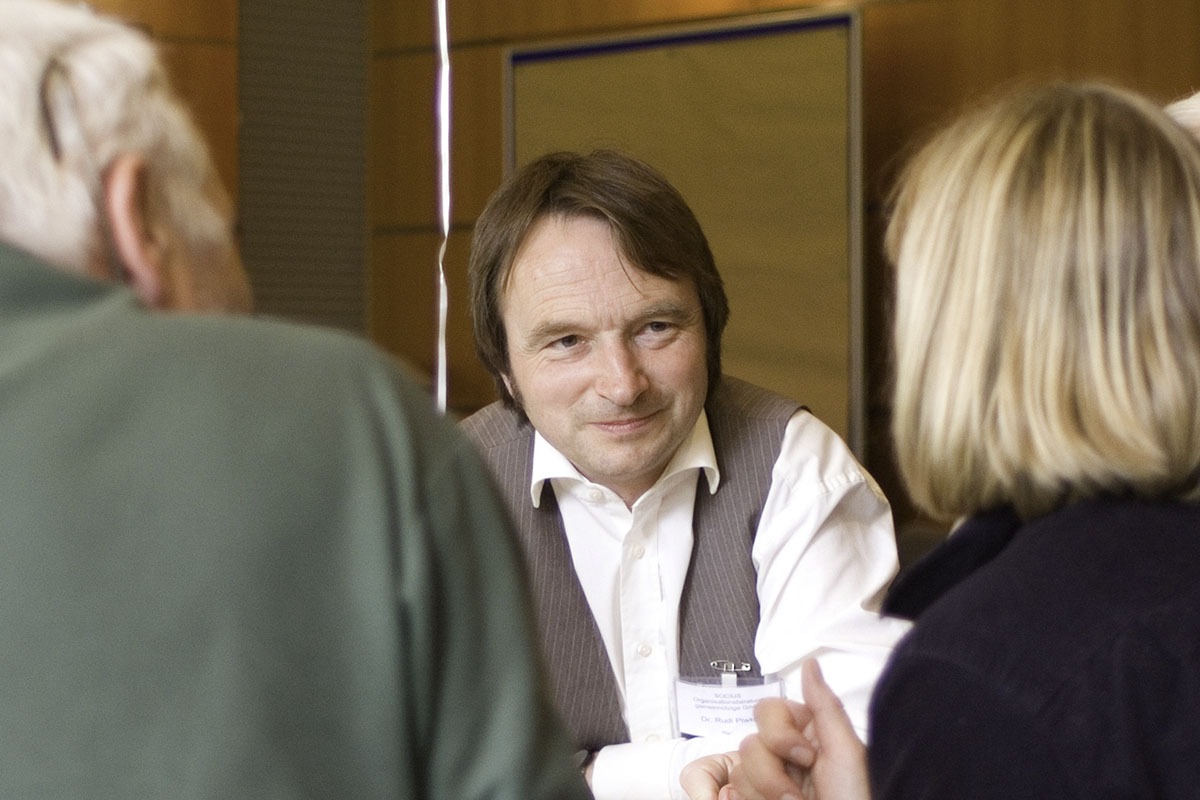
I wanted to know how Socius holds charitable organisations accountable with this statement, but Rudi Piwko, the founder of Socius, did not want to talk about accountability at all. Instead, he wanted to talk about joy, not in a spiritual sense, but in a pleasurable, hedonistic sense.
Organisational development as a hedonistic pleasure – how does that work?
Rudi Piwko: It is the joy of continuing to learn myself and, above all, the joy of the trust that is placed in me. There are two ways in which you can support development as a coach. One is to fly above like a helicopter and gain an overview of the organisation of a company, but remain at a distance. The other is to go in and act as a kind of medium, tapping into feelings and reflecting them back – this method suits us better.
What kind of structures that need „development aid“ do you find?
Rudi Piwko: That varies greatly. For example, there was an association that had grown very quickly in recent years and was now faced with the challenge of involving all employees, including volunteers, in the decision-making process.
Isn't it extremely time-consuming to always discuss everything with everyone?
Rudi Piwko: Very much so. Many people think they cannot afford it. I always argue with the costs that arise when you fail to do so. The Titanic did not sink because people did not work well, but because there was an information leak.
This association I was talking about was not threatened with collapse. On the contrary. But they felt that they needed help, that something was amiss. It was about developing a culture of dialogue, about quality of work and quality of life.
I understand what you mean. Sometimes you walk into a company and you can sense the atmosphere there as soon as you greet the receptionist.
Rudi Piwko: Yes, exactly, but it's not always black and white. There was also an organisation where everything seemed fine at first glance. Everyone was friendly. But suddenly we realised that they were overwhelmed. They had been working for years in a house that had been given to them, but now it had become too small. Even the last corner was filled with things. This stressed the employees. Ultimately, it can be quite mundane causes that cause problems.
How do you proceed? What is the first step on the path to hedonistic joy, accompanying an organisation through a development process?
Rudi Piwko: In the case of the association, we started with the management team. I conducted individual interviews with each member. However, these were only intended to find a method of proceeding. In the workshop that followed, everyone then engaged in conversation with each other. Our task was essentially to provide space and time – and an occasion. Using emotions and relationships to ultimately start a conversation about processes is a simple, effective approach.
What role did you play in the workshop?
Rudi Piwko: I was more of an observer and reflected back to the participants what I felt. I always remain in the here and now, so I don't speculate about the past or background information. That is also a great source of joy in development processes: staying in the here and now. We also don't judge, we rarely look for someone to blame, because I believe that everything has its justification. Much of what no longer works is also the result of a development that has taken place. You have to find that out and appreciate it.
What was the result of your joyful intervention?
Rudi Piwko: How would you describe the outcome of a tree? Our goal is to encourage employees to prioritise dialogue with colleagues and the HOW of collaboration over the specific objectives of their work. As previously mentioned, it is about establishing a new culture, moving away from the dangerous motto: ‚The end justifies the means’. We strive to align the end and the means.
Socius has also grown rapidly over the past year. You now have offices in Munich, Hamburg and Cologne. Are you facing similar challenges to this large association?
Rudi Piwko: Organising our own development is currently my greatest joy. It is the joy of self-reflection. Because now we have the opportunity to demonstrate the positive view of humanity that underpins our consulting services in our own corporate structure. We work transparently, value openness and place relationships at the centre of our work. The quality of our work depends not least on our own cooperation. We, too, are now faced with the challenge – as are our counterparts – of allowing ourselves enough time and space for our commonalities. We believe that our „customers“ – our partners – will notice this.
Incidentally, in the past ten years, no one who joined Socius has ever left. This satisfaction probably stems from the many opportunities for creativity. In any case, we are crafting our own career ladders. We have just added another rung. Until now, I was the managing director. Now I am the chairman of the cooperative that will form the umbrella organisation for the four companies in Berlin, Hamburg, Cologne and Munich, and Andreas Knoth is my successor as managing director of Socius Berlin gGmbH. It's a bit like trees growing.
Why do you only offer your consulting services to non-profit organisations? It would be particularly important to establish this new culture in the private sector.
Rudi Piwko: This has to do with our background. Each of us has already set up an NGO or played a significant role in one. We are at home in a certain culture; you could say that non-profit organisations often have an excess of meaning. We are familiar with that. For those who work at Terre des Hommes, money is not necessarily the main factor at the end of the day. If you produce screws that are used in both tanks and wind turbines, you have to sit down and construct that meaning.
But I also see a major shift in the economy. More and more entrepreneurs are realising that the more they care about how their products are made, the better those products become. And that is also our goal: to prove that this is more effective than focusing purely on profit or the product itself. And the result achieved with joy is usually also the better result. Whether in business or in organisations oriented towards the common good.
17 July 2013
 Deutsch
  English (UK)