


In our new category, „SOCIA Outlook,“ we want to try to regularly focus our attention on the situations of women* in working life in NGOs, in the consulting business, and in leadership positions.
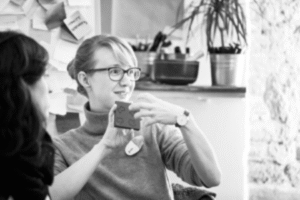 As the year draws to a close, there is Julia Hoffmann Answers to our questions. We are delighted that next year we will be able to read insights into the thoughts and ideas of Hannah Kalhorn and Lysan Escher. Before other colleagues from the SOCIUS NextWerk take us along...
What do you think is the best way to change society?
For me, these are three important ways to bring about social change:
- To consciously bring to mind and critically question the “inner stories” in which we live and which shape our actions – and to continue writing them ourselves. By inner stories, I mean narratives or stories – these can be large social narratives or very personal ones. Such an inner story can be called “I can't do this” or “I open myself to the unknown”. The more aware we are of these narratives that influence us, the more conscious we become in our actions. And we can change them, e.g. to “I belong”.
- Questioning issues: Questioning the major social issues that concern our society. A while ago, I read the question “Does Islam belong in Germany?” on the cover of SPIEGEL magazine. In my view, this is not about the whether – it's about the how. If the question were, “How does Islam belong to Germany?” or “How does Christianity belong to Germany?”, we would be in a completely different discourse. One that is guided by curiosity and exploration, rather than one that begins with judgement.
- Many small steps and micro-changes that each and every one of us can make. Over years, decades and sometimes centuries, these can grow into movements and massive changes, such as women's suffrage or the fall of the Berlin Wall.
How did you get your job?
The word “job” doesn't really apply here; it's more of a role or activity. I'm here because I've been working in voluntary and non-governmental organisations for many, many years, in fact for as long as I can remember. In addition, after a while I increasingly found myself in roles that involved bringing people together, organising projects and taking responsibility for them. I found myself increasingly using a flipchart and pen, listening to others and then keeping track of the common threads in our discussions, meetings and strategies. This gave rise to my way of facilitating processes, both as a moderator and visually, using my pen to tease out and highlight our collective knowledge. .
What do you want to achieve with your job?
I want to enable the teams, groups and individuals I work with to understand and shape what is important to them with clarity, strength and creativity – regardless of whether it is a challenge or an obstacle standing in their way. I want to create space for deep collective thinking and ensure that each individual feels invited to contribute what is important to them for the joint project.
What profession did you want to learn when you were a girl?
I wanted to do lots and lots of different things: ballerina, horse groom, designer and interior designer. Later on, I wanted to become an ambassador in France, a Member of the European Parliament, a psychologist or a photographer. It was quite difficult to decide on a path among all these possible directions. Even today, I still enjoy discovering different career paths. I wouldn't rule out the possibility of doing something else again at some point.
Who or what do you admire at the moment?
Nature: It's amazing how compost – a place where you collect only waste and then leave it to rest or lie for long enough – produces the most nutrient-rich soil, or mother earth. I find this form of regeneration incredible. Suddenly, “rest” takes on a whole new meaning.
What does a dream of a better world look like?
It is a world in which we can prevent things from getting much, much worse by looking at nature. My dream is that we all become deeply aware of how valuable this resource, this planet, is. It is a world in which we humans share this knowledge, act on it and truly change our behaviour as a community – rapidly, effectively and with understanding and compassion for each other for the emotionality that these changes will provoke.
What does success mean to you?
For me, success here means impact, ideally a profound impact. In a professional sense, this ties in with what I mentioned earlier: opening up and maintaining spaces where creativity can flourish again; spaces where teams can find common ground in a shared vision or in a moment of deep understanding of one another.
Which mistake have you learned the most from?
I have learnt a great deal from discussions about finances and salaries, and I am still learning. I find money a difficult topic in general – in my experience, it triggers deep-seated “inner stories” in many of us.
Do you see yourself as a role model?
As someone who is one of the “quieter people,” I have often appreciated those who, despite their clear reserve in groups or conversations, have spoken up at a certain point. Most of the time, they listened carefully first. But what came next had a depth to it and made me realise that we quieter characters also belong. I hope that I can inspire people who are similar to me and show them that there is a place for us too in this often noisy world.
Do you have a principle that you live by?
“Everything that is, may be. And what may be, can change.” That's a quote from Gestalt theory. My family now quotes it back to me because I've used it so often in everyday situations with them. I don't know if I live completely by it, but I certainly try.
What does feminism mean to you?
For me, feminism is a political stance that raises clear questions about social structures, cultural patterns and individuals' opportunities for personal development. It is a stance that considers how differently certain groups participate in society and how powerful or influential they are – and dreams of a world in which all people are equally important.
How do you live feminism in your team?
I try to keep an eye on issues of rank and power, to address the topic of gender more openly, and to help make it easier to talk about.
How do you try to improve the visibility of minorities in your team?
I try to bring up topics and questions that are not equally pressing for everyone. And to keep us aware that we can do even more and grow even further here.
What family-friendly measures could you implement in your team?
I find SOCIUS to be very flexible when it comes to family needs, and I have the confidence and experience to know that my colleagues will be understanding and supportive when needed.
What advice would you give to younger women and those starting their careers?
Alongside all the realism and security issues that determine career paths, don't forget to ask yourself: What do I really enjoy doing? What activities make me lose track of time? What are my dreams? Whatever you do, take some of these ingredients with you into your professional life and keep your curiosity alive.
 Deutsch
  English (UK)