


“We are in a new spiral of fundamental change. It needs to happen because we have unsustainable ways of living. We need to learn new perceptions of life and to see life differently.” Maria Scordialos
„The major problems in the world are the result of the difference between how nature works and the way people think. There are times when I catch myself believing there is something which is separate from something else. Gregory Bateson
The SOCIUS team is buzzing with discussion on the topic of regenerative cultures. This outline sketches the three concepts of “living systems”, “regenerative cultures” and “regenerative leadership” that shape discourse and practice. We are concerned with the question of what qualities we want to develop in systems, including our own, as well as how these approaches shape thinking and action in ecosystems and communities.
Living Systems
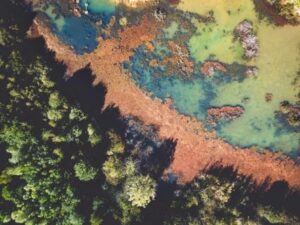
The paradigm of living systems is fundamental to a development towards regenerative ways of being and acting with ourselves, with each other, and in our organisations, communities and projects. Through the eyes of living systems, we understand life itself as an interconnected system. We look at relationships, patterns, context and the big picture when we face challenges and problems that we encounter. Networks are the fundamental organisational structure in this paradigm.
Older paradigms are characterised by perceiving life primarily in terms of its individual elements. For a long time, such divisive attitudes have shaped our world. They are often deeply rooted in the way social systems, e.g. education, health care or economic systems, and also our organisations have been created.
In contrast, the wholeness of life is fundamental to the perspective of living systems.
There are more examples and research that describe the holism of life as fundamental and basic. As humans, we are part of the greater whole, part of nature and connected to all other living beings – fish, trees, mountains, oceans ... More and more research also proves that Darwin's idea of “the strongest prevail” is not exclusive – and that evolution is largely characterised by collaboration. For example, forest ecologist Suzanne Simard has proven in recent decades that forests are collaborative ecosystems and that trees support each other and other species in their development – and not, as assumed for decades, that trees compete for the most daylight. Such forms of collaboration go hand in hand with resistance and creative friction, which gives rise to new things.
This paradigm forms, among other things, the basis of the practice of “Art of Hosting”.
Regenerative Cultures
Living systems are regenerative systems.
Fritjof Capra & Daniel Wahl (2020)
The concept regenerative cultures (“Regenerative Cultures”) describes attitudes and practices that are not only sustainable, but also transform their respective environments in a positive direction. Guided by an inner attitude of abundance, it is now urgent to ask new questions that systematically examine the role of design, technology and planning – and their impact on planetary health:
„We need to design for human, ecosystem and planetary health. […] Let us ask ourselves: How do we create design, technology, planning and policy decisions that positively support human, community and environmental health? […]
If we meet the challenge of decreasing demand and consumption globally while replenishing resources through regenerative design and technology, we have a chance of making it through the eye of the needle and creating a regenerative human civilisation. This shift will entail a transformation of the material resource basis of our civilisation, away from fossil resources and towards renewably regenerated biological resources, along with a radical increase in resource efficiency and recycling.“
Daniel Wahl (2017): Sustainability is not enough – we need regenerative cultures. Medium.com
As Wahl goes on to write, this encompasses more than technical, economic, ecological or social shifts – our inner attitudes and understanding of ourselves and each other as human beings and nature are shaping these changes.
At this point, it is worth taking a look at the concept of regenerative leadership.
Regenerative leadership
Laura Storm and Giles Hutchins describe regenerative leadership in their book of the same name. book as an equivalent triad consisting of 1) understanding oneself as a “living systems being”, 2) transferring and integrating knowledge from other living cultures such as permaculture, sociology or deep ecology (“living systems culture”) and 3) designing our interactions, organisations, projects, communities, etc. on the basis of living systems (“living system design”).
Storm and Hutchins emphasise that personal inner development, understanding oneself as a living systems being, is the central point and beginning of social transformation. By this they mean qualities such as living in rhythm with the seasons, viewing the world with an inner attitude of abundance, and understanding ourselves as fertile ground for development that needs to be well and deeply nourished.
We look forward to further exploring the topics and concepts presented here. If you are interested in learning more, you can delve deeper into the subject here:
- Sustainability is not enough – we need regenerative cultures (Article by Daniel Wahl)
- Maria Scordialos: Art of Hosting – Living Systems Worldview (video)
- Fritjof Capra & Daniel Wahl (2020). Living Systems are regenerative systems (Article)
- Daniel Wahl: Designing Regenerative Cultures (book)
- Laura Storm & Giles Hutchins: Regenerative Leadership (book)
- Suzanne Simard: Forests are wired for wisdom (podcast)
 Deutsch
  English (UK)