

Transformation is long-term, profound and process-based, which in this combination is already somewhat unreasonable.If everything is a process, a constant state of flux, a continuous flow of creative destruction and renewal, we run the risk of losing our bearings. As if the world were not already dynamic, complex and crisis-ridden enough, we, as protagonists of social transformation, are also undertaking a crossing of the ocean, the other shore of which has been sung about but not yet mapped. Where there is no home base, no safe space to retreat to, the world out there becomes a constant arena of expansion, in extreme cases a zone of panic.
So, one question that is not entirely insignificant is: What is a convincing „stable body“ for the transformative journey?How do we structure vessels that protect us from crises and the shivers of constant adaptation, while simultaneously transforming ourselves and the world around us? Is the good old „organisation“ still the best answer? Do classical institutions have the transformative power we need to overcome our „wicked problems“? Asked from the other side: Can open communities and social movements provide the stable zones we need to orient ourselves and regenerate in the midst of all this change?
The structural aspect of transformation has not yet been fully explored, but the times are ripe for a little field reflection. What otherwise shimmers in many colours is exaggerated in a simplistic manner during the crisis. When looking at the Covid universe, the following stand out: two transformative configurations emerge – with Sloterdijk, one could describe them as „bubbles“ and „foams“. (The following considerations do not fully reflect Sloterdijk's original train of thought on these categories. Anyone interested in this topic is recommended to read the 2,500-page Sphere Trilogy).
The „bubble“ follows the idea of a closed system, a sphere that protects its interior from the storms of the world.. Their membrane is designed to reduce complexity and limit impulses from and to the outside world. It is resilient, not because it adapts, but because it encapsulates itself. The bubble is a space of focused relationships. Idealistic communities and collectives have the quality of bubbles – they are constructed as counterworlds, as „islands of sanity“ (Meg Wheatley) – in the best case, they become places of self-development and utopian incubation.
In contrast to guerrilla gardening interventions, which are planted in public spaces and radiate out into their surroundings from there, exposed to all weathers, the bubble is a Greenhouse for new microsystems, whose transformative effect is only realised when it reverberates back into the overarching „parent system“. Until then, its transformation is primarily self-transformation.. Many initiatives and organisations have pulled the covers over their heads in the ongoing COVID storm and hibernated in their bubbles. Some of them are emerging changed, with new ideas and momentum for social change. Others have become echo chambers and self-referential systems. Bubbles have transformative potential, but not every bubble ends up being transformative.

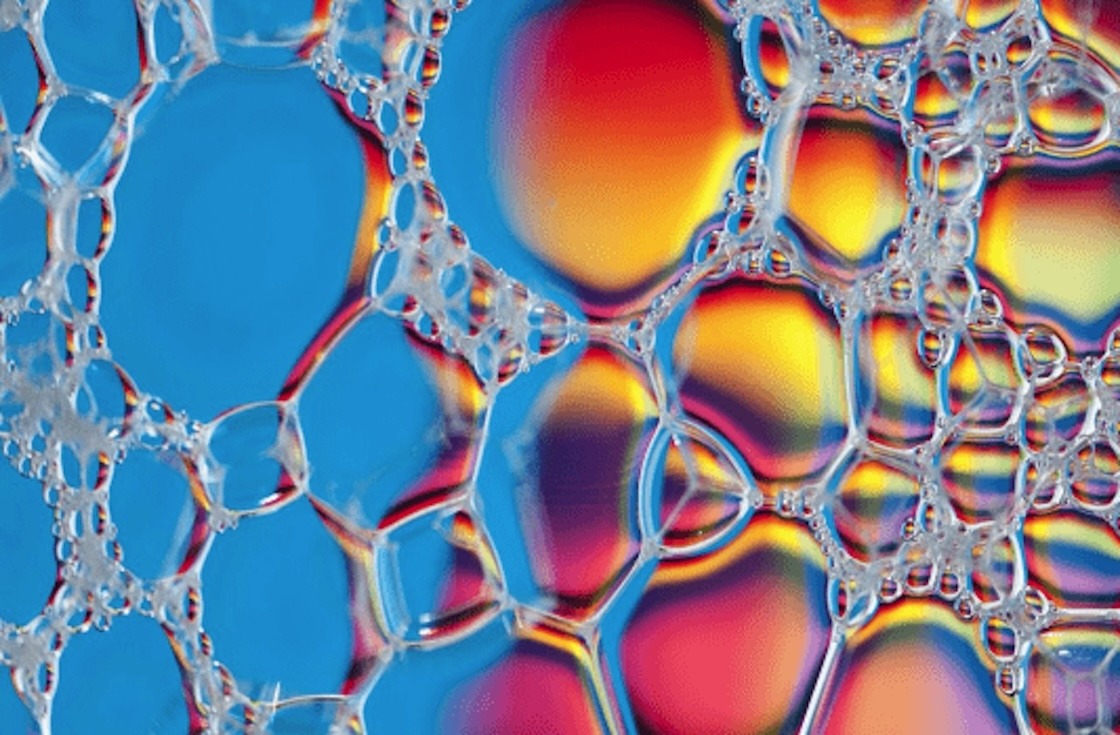
The „foam“, in turn, is based on connectedness and movement. It is composed of many smaller bubbles that form organically developing constellations. A foam is an open system. In organisational terms, it is looser than a network, which, strictly defined, presupposes a common purpose and a collective striving for action. Each bubble in a foam remains its own sovereign entity and follows its own logic. Nevertheless, a foam is more than just a random collection: it is a plural sphere of jointly developing entities between which a common purpose emerges. can. In this sense, it is more of a field than a structure.
Like the bubble, foam also proves to be extremely resilient in times of crisis. The secret of its resilience lies in the difference between static and dynamic stability. While the classic idea of stability is associated with fixed coupling (things are so firmly connected that they can withstand any storm), there is a second type of stability that is associated with the ability to bend rather than break (reeds, for example, are dynamically stable). In social systems, dynamic stability is made possible by the loose coupling of units. Loose coupling means that the subsystems are not connected by direction and control, but by lateral coordination and negotiation. Instead of static rules and regulations, they are coordinated by principles or cultural norms. When an organisation or network has to balance highly conflicting stakeholder relationships or is exposed to very turbulent environments, loose coupling helps to ensure their adaptive integration. It also prevents domino effects in crises, as local conflicts and solutions become learning fields for the entire system, making it stronger under stress (a property that Nicholas Taleb calls „antifragility“). Networks are loosely coupled. Foams are ultra-loosely coupled.
Foam structures can be found in organisational ecosystems and networked communities. Where their common purpose becomes clear, their transformative nature becomes more obvious – but that is only half the story: It is the unintentional nature of foam that enables innovative solutions: foams change their shape and continuously adapt their configurations in a series of evolutionary steps.Bubbles appear, bubbles disappear, bubbles merge and divide, relationships and collective patterns of action change with internal and external dynamics. Each foam state resembles a „provisional order“ – an arrangement that could be final, but could also be reconfigured in the next moment. Even if there are key players driving the process forward, the development cannot be attributed to individual actions – it is collective and emergent. And although foam is inherently transient, its transformative power lies precisely in this dynamic prototyping quality. Once a foam constellation has proven to be „functional“ in relation to a problem, it becomes the blueprint for the further development of the system. The bubbles involved (initiatives, organisations, communities) do not necessarily have to take over the long-term operation of the function. They merely produce a working model that can be copied and adopted by established social institutions. In evolutionary terms: The foam innovates, the system replicates and scales to an effective level.
The need for solidarity and mutual support, the obvious complexity of global challenges, the exploration of new cooperation strategies and the explosive growth of virtual collaboration have contributed to the formation of foam in the community and civil society sector during the coronavirus pandemic. The transformative effect of this development, the impact of „TransFOAMation“, is already visible, but its sustainability must be monitored further.
The bubble and the foam are just two possible transformative constellations. Many different structures are possible for social change – some that give shape to reform or even revolt against the established system. Some that relate to the creation and release of new alternative microsystems. And finally, some that function as containers of self-transformation. None of them will be successful on their own; all are necessary to help shape sustainable change. So let's continue our research!
 Deutsch
  English (UK)