
A small miracle in May
Art of Hosting & Harvesting Training in Leipzig
Author: Julia Hoffmann

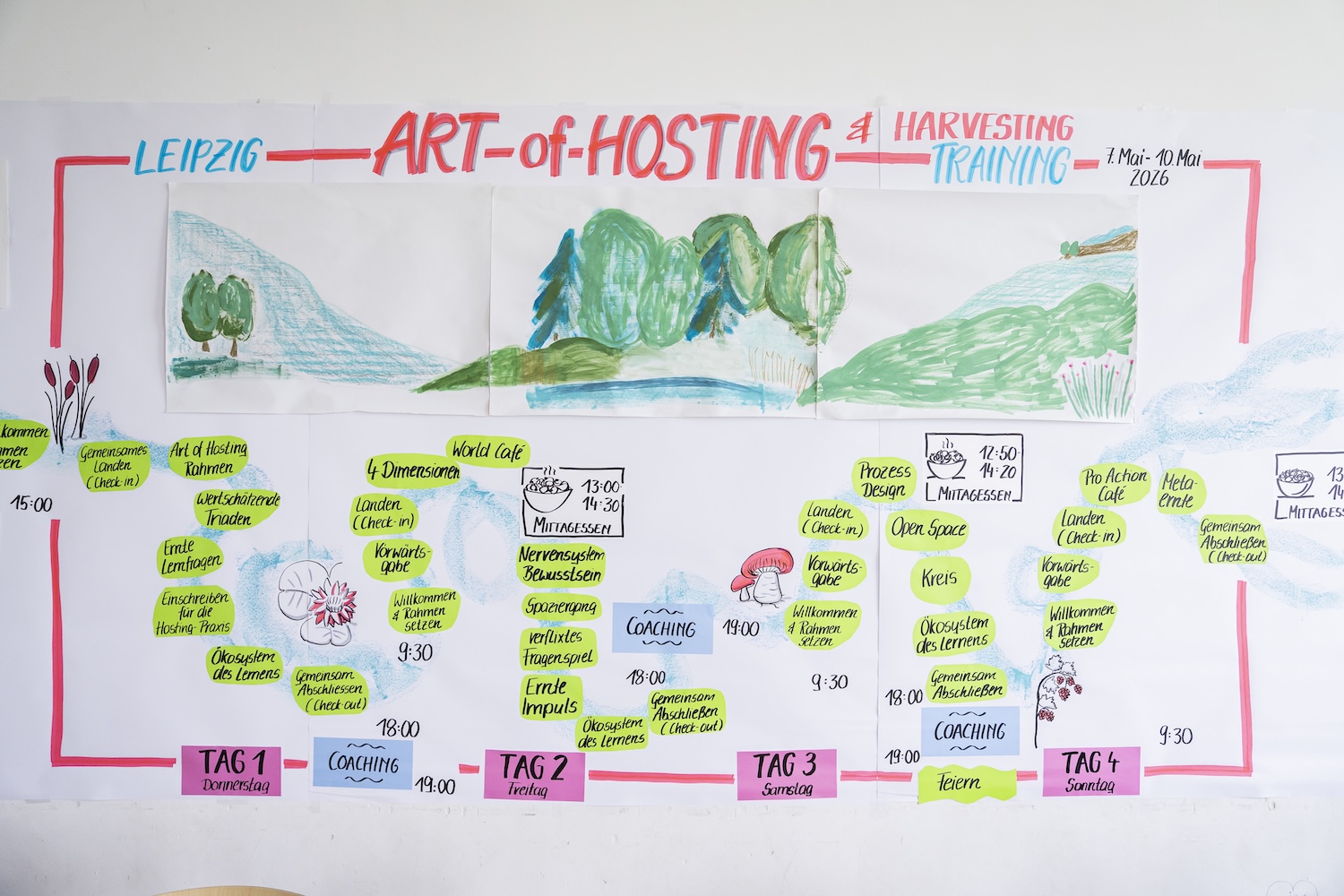
Four days, one auditorium, one question that calls out: How do we shape our relationships with one another in uncertain times – and embrace our differences as a source of connection? A look back, a harvest, an invitation.
„Beyond right and wrong lies a place – that is where we meet." — Rumi
Arrival: An auditorium in Leipzig
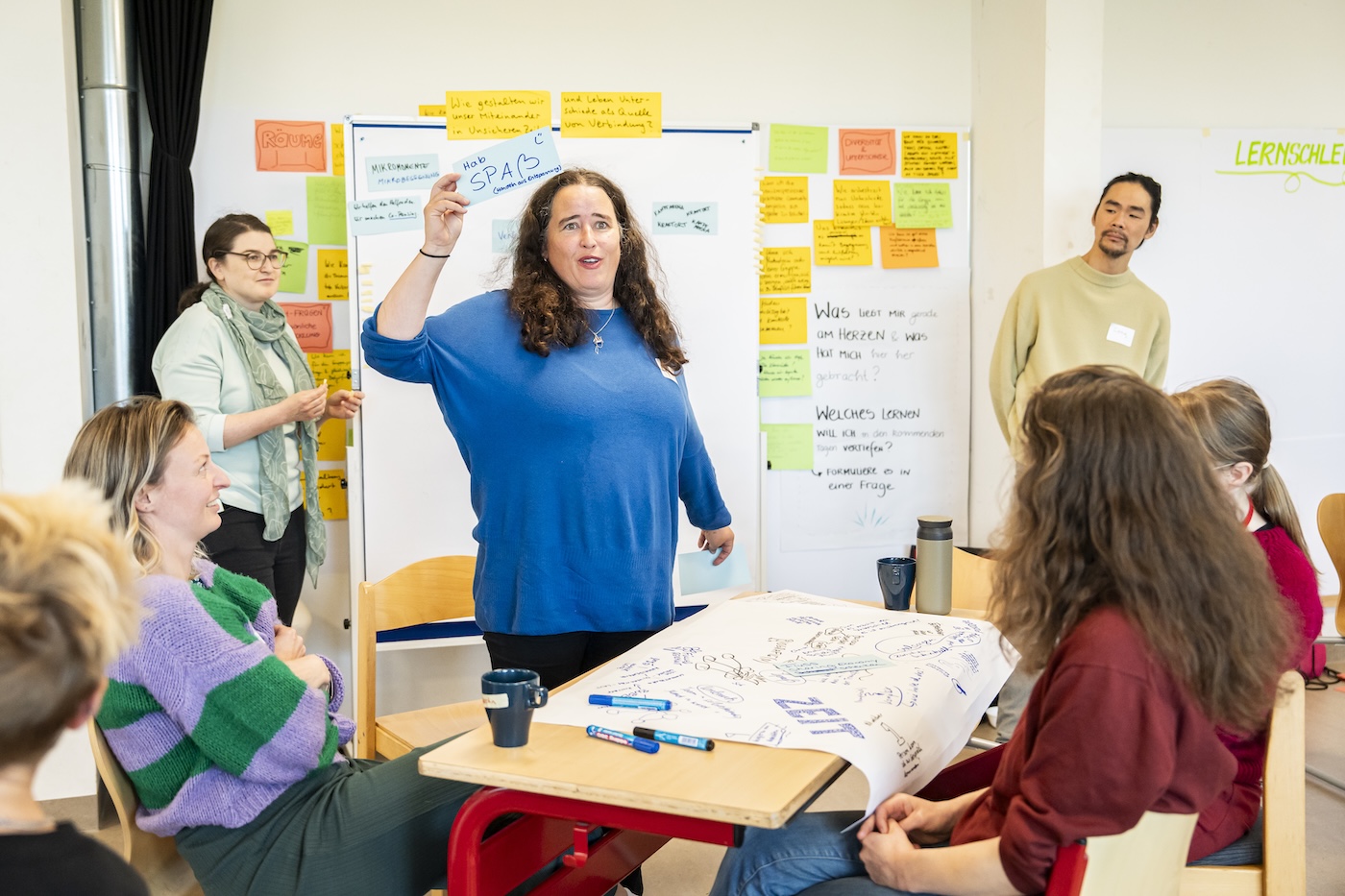
Imagine a school hall – right at the top of a prefab block in Leipzig-Grünau. From the windows, you look out onto more prefab blocks and plenty of greenery, and at a May sky that, on days like these, tends to be a rather blue-grey. No idyllic conference centre, no seminar hotel in the countryside by a lake. Instead: a circle of chairs rather than rows of seats. And over the course of four days, ‘harvest walls’ spring up on the walls – flipcharts, drawings, questions on facilitation cards and Post-its, sketches and more.
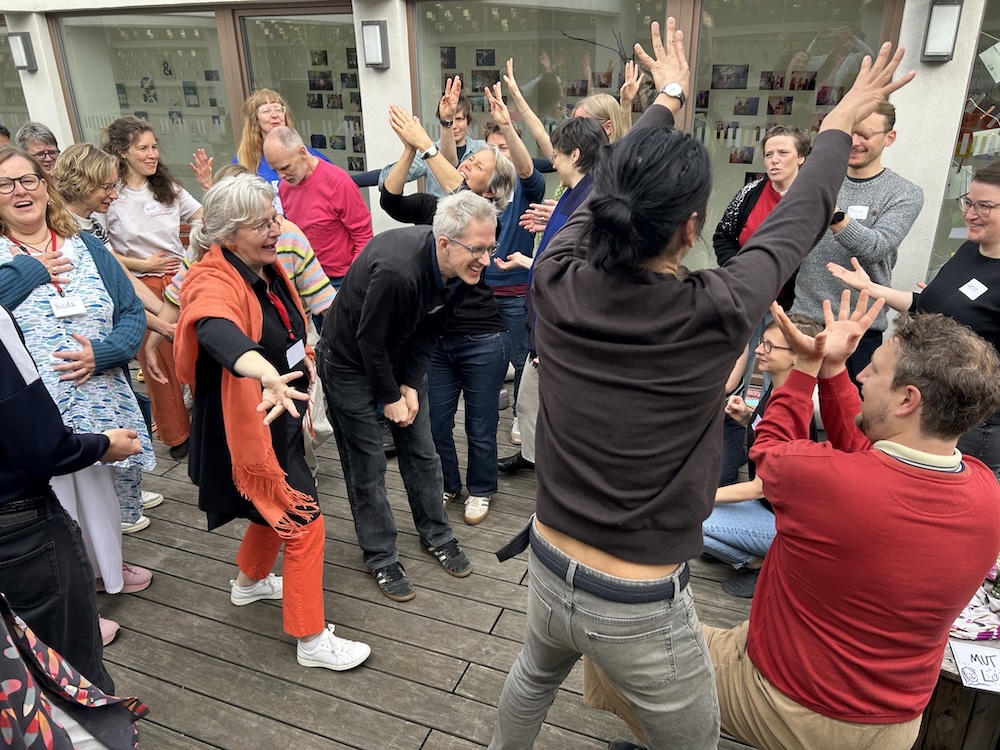
In May 2026, this venue was the Freie Schule Leipzig. During the four days of our training, its assembly hall became a practical arena for the art of hosting and cultivating conversations that move people – which is my favourite German translation of what is referred to in the original English as AThe Art of Hosting & Harvesting Conversations that Matter is known.
This is exactly the right place to ask and explore what a sense of belonging might mean. Grünau is one of those places that many people only know through the labels attached to it – as I did, before we arrived there.
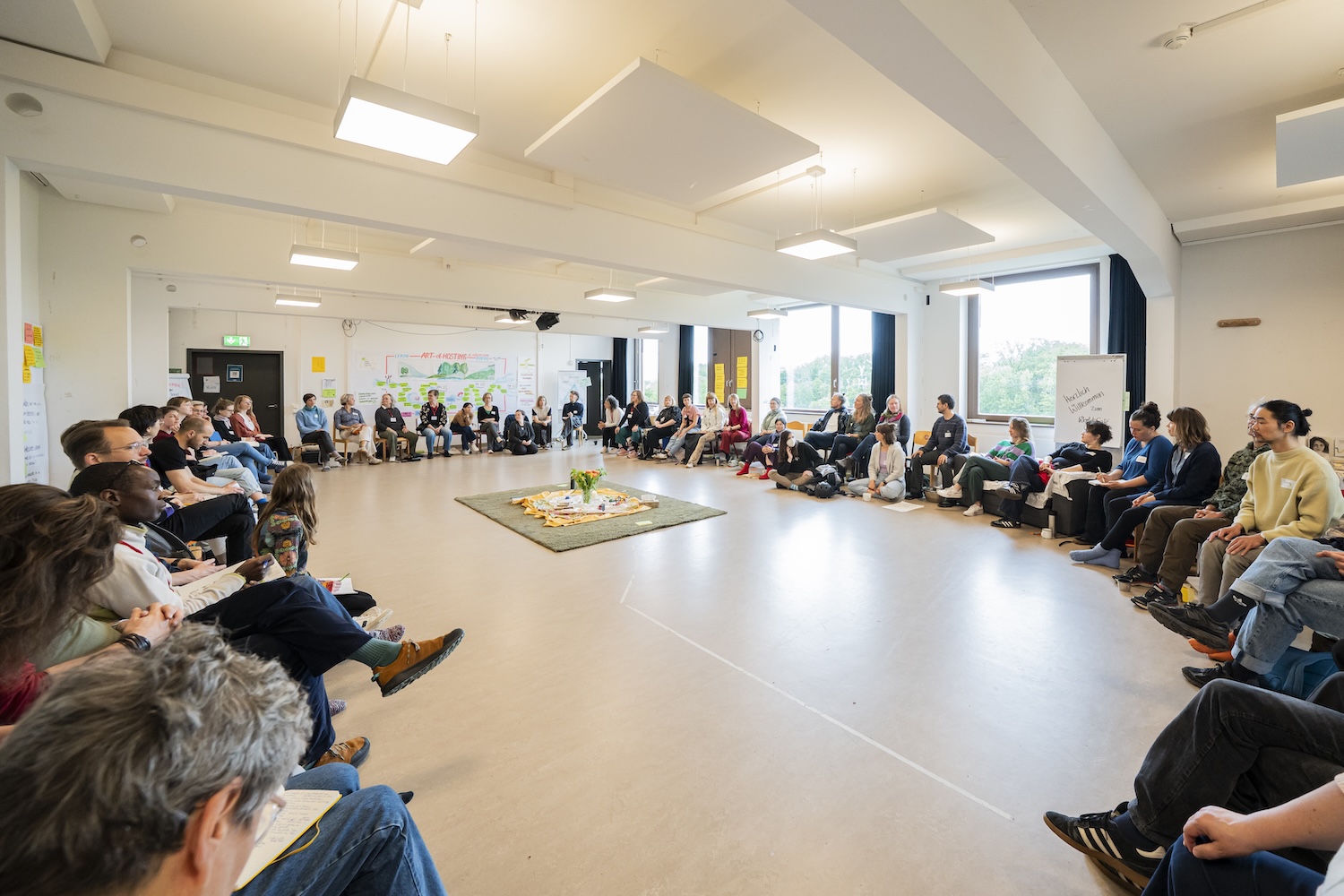
I’m writing this a few weeks later, and it’s still resonating with me. AoH Leipzig, you were incredible. I had no real idea what lay in store for me – and for us. It was: intense, thrilling, funny, quiet, loud, courageous, sad, difficult, moving, vibrant. A little miracle in May.
But let’s take it one step at a time. Because this training had a root – or rather, a seed.
The Seed: An East German Question
At the SOCIUS oe Day 2025, we explored a question that is also close to my heart: what does it mean to navigate the world and organisations with a background rooted in either East or West Germany? Thirty-five years after the fall of the Berlin Wall, German reunification has many facets: some are visible in figures and structures, others are hidden in personal histories, attitudes and patterns of speech. And still others only become apparent in those subtle moments of misunderstanding or confusion in everyday working life.
I am someone with a background in East Germany. For a long time, I experienced this as a sense of inner separation – a quiet belief that kept whispering to me: You’re not one of them. I firmly believe – and I have now seen for myself – that things can be different: I can belong and to be different. And I think we need more of those spaces, moments and experiences. Working together to find out what paths lead there – and what obstacles lie along the way – has become essential to me.
In her poem „Where I Come From", the poet Jasmin Brückner asks what one does, as a human being, with this dual, wordless feeling: of identifying so deeply with a region – and at the same time distancing oneself from it so greatly. What do you do with the sense of connection, the memories, the nostalgia? When I read her lines for the first time, I thought: that’s exactly where I want to go – to places like these, to people with stories like these. To invite them: into conversations, into learning together, into creating spaces that can foster a sense of belonging and connection.
“East” and “West” are still very much a reality in Germany, even if this is not always apparent. The sociologist Steffen Mau speaks of a „phantom border" that continues to run through the country and makes it difficult to feel a sense of belonging. A study by the Robert Bosch Stiftung in collaboration with More in Common reveals an illuminating pattern: the idea of democracy is widely shared in both the East and the West – yet the degree of commitment to it varies. In the East, only 38 % say an explicit ‘yes’, compared with 50 % in the West. And the same study identifies a crisis of trust and discourse: there is a lack of spaces where people can engage in conversation that brings them together.
The SOCIUS oe-Tag 2025 sparked a desire in me to do more: to weave my long-standing practice of the Art of Hosting into the SOCIUS field – and to see what emerges when we bring this to Leipzig. After all, if you look at the map of German-language Art of Hosting training courses, you’ll see that they’re held in Bad Boll near Stuttgart, in Austria, in Switzerland, in Hamburg or Kiel in the north – and in Berlin, mostly in English. East Germany? Bringing this approach here too was a priority for me. Because I find it valuable: it fosters connection and complements many other practices.
At the same time, it was important to me that this didn’t become an „Eastern" issue. East and West are just one dividing line among many – there are so many other factors and identities alongside them: background, class, gender, age, educational pathways, bodies, languages. A sense of belonging is never determined by just one dividing line. That is why this has become a workshop for anyone who wants to take part: a space where we can build skills together – to shape, hold and reap the benefits of conversations.
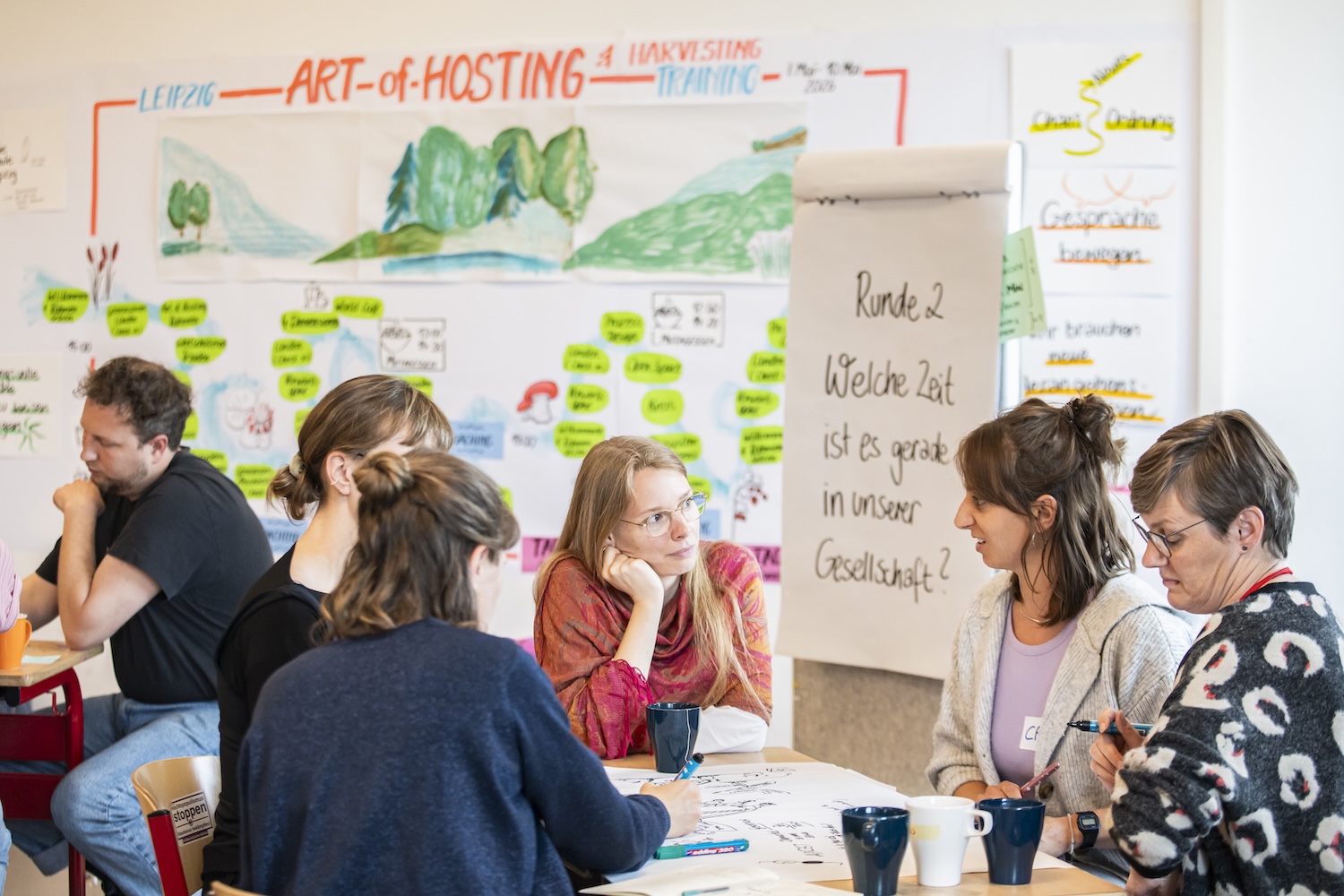
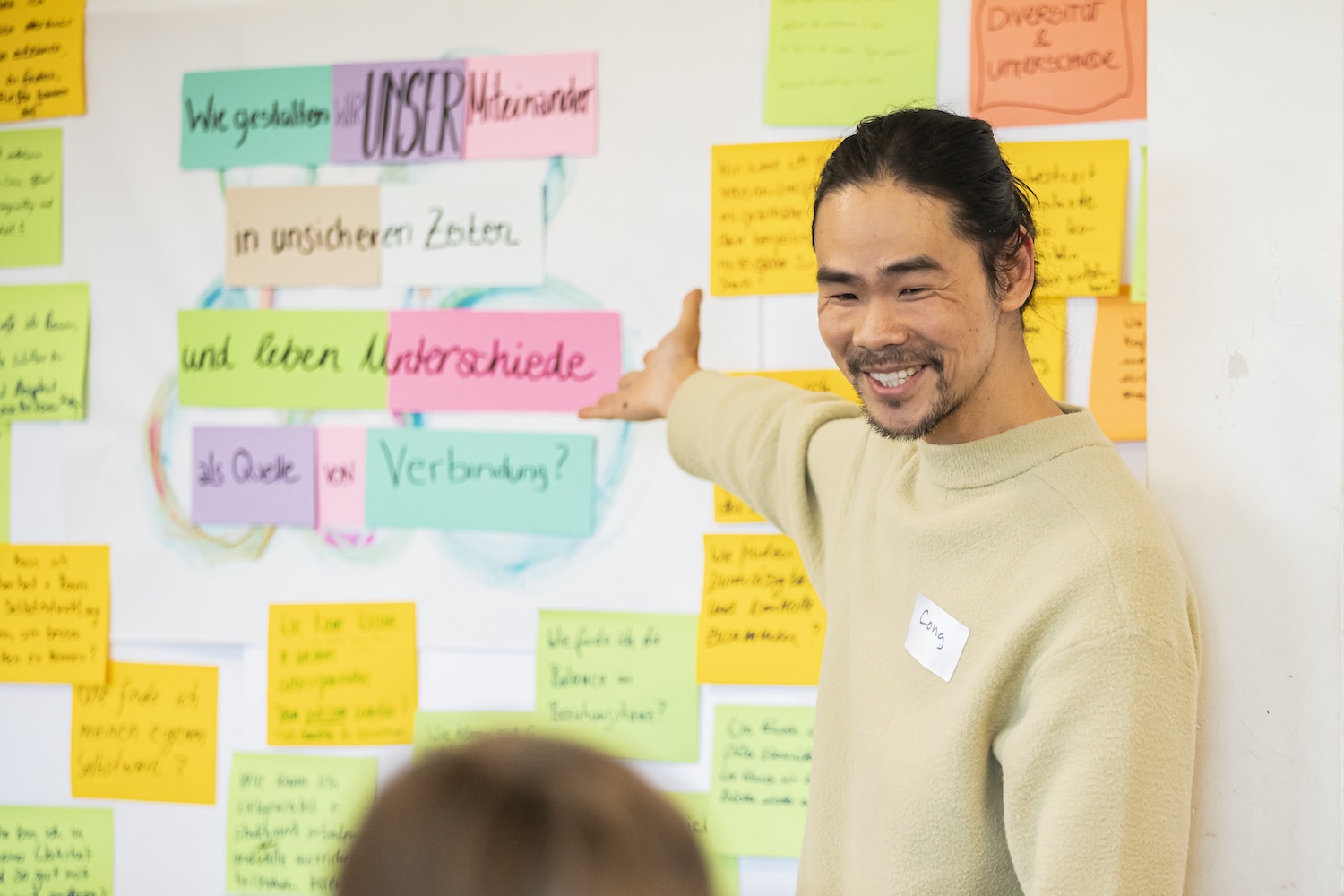
It doesn’t start with tools. It starts with conversations.
We are living in times of fundamental change. Old answers no longer go far enough – and new ones are often not yet in place. In between: uncertainty, tension, a sense of searching.
For me, the Art of Hosting & Harvesting lies precisely here. Not as a perfect method, but as a practice, an attitude and a sense of grounding. As an anchor – and as a living ecosystem of people who are prepared to expose themselves to the in-between.
The Art of Hosting does not begin with tools. It begins with conversations and dialogue. For conversations are vessels for transformation: for what seeks to emerge when we truly listen; for collective intelligence; and for wise action. Research into the Conversational Intelligence (Judith Glaser) shows just how much conversations shape trust, cooperation and security: divisive conversations foster defensiveness and division; empowering conversations foster connection and creativity. They lead from a „power over" to a „power with" – and that is precisely where democratic culture begins.
What has moved me about this practice for years:
That transformation arises in the space between chaos and order. That tensions, contrasts and paradoxes are not resolved, but held. That “meaningful conversation” is a profoundly human capacity when it comes to the new. And that learning is never complete – but rather a journey along the chaordic path.
And yes: almost as an afterthought, Art of Hosting is also a powerful suite of formats – Circle Practice, World Café, Open Space, collective harvesting practices and much more. But anyone who focuses solely on the formats has missed the point. Self-organisation is the real core – and self-organisation is political. The trick lies in the rotation: everyone takes turns hosting, and everyone takes turns being hosted. Leadership rotates. Responsibility circulates.
Belonging is not about agreement. Belonging is a practice.
Our ‘Calling Question’ – the question that brought us all to Leipzig – was:
How do we shape our togetherness in uncertain times and live differences as a source of connection?
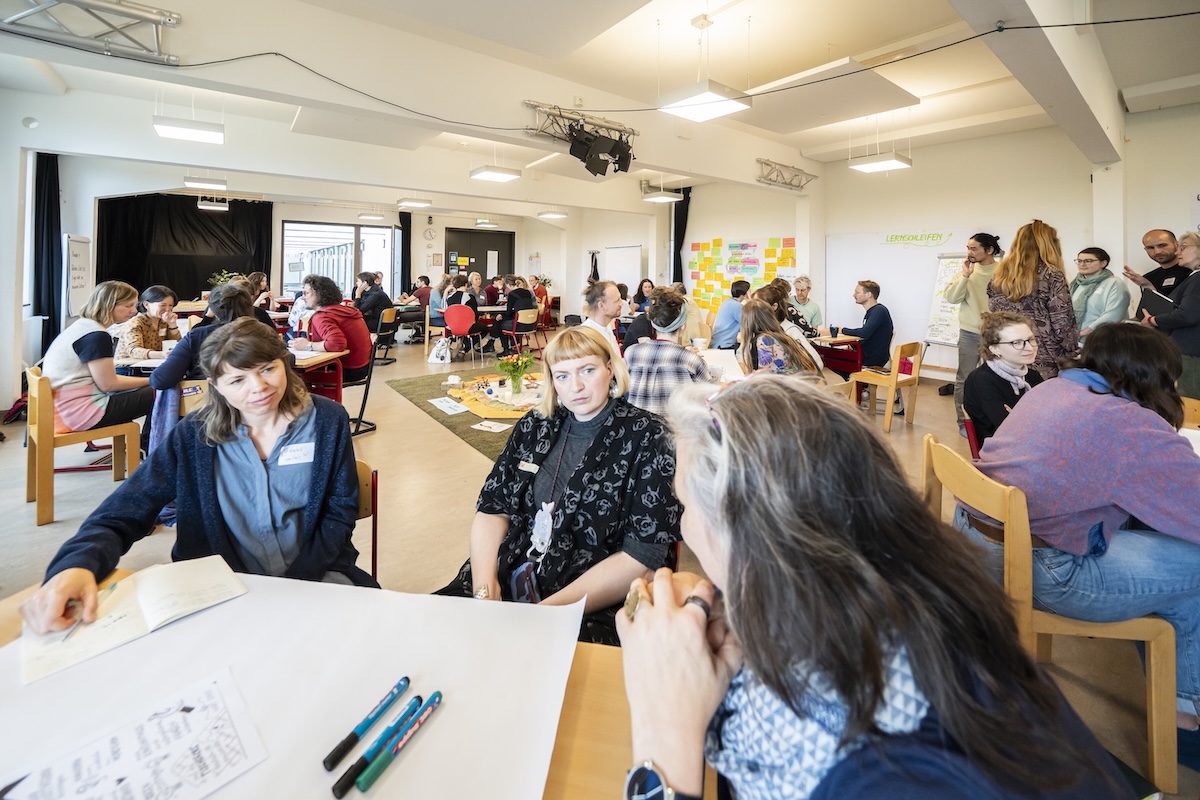
Behind this question lies an attitude that I have noticed in the Othering & Belonging Institute find in Berkeley: Belonging is both – a feeling and A practice. Something we experience personally, and something we create collectively. It is not about everyone becoming the same or merging into a grand consensus. It is about an ever-widening circle that recognises the dignity and humanity of everyone – including, and especially, those who are different from me.
In Leipzig, we didn’t treat this as a theory, but as a testing ground. Solidarity not as a consensus, but as a social practice: as an attitude of listening to one another without immediately passing judgement. As the ability to endure tensions without smoothing them over. As the courage not only to allow diversity, but to live it.
Perhaps my most important realisation from these four days can be summed up in a single image: We can set our differences aside. Like objects in the centre of a circle. They do not have to merge. They do not have to contradict one another. They are simply allowed to be there – visible, acknowledged, in relationship. Being connected does not have to mean total absorption. It can be a matter of recognition.
The paradox is always at play
I didn’t first encounter this paradox in the training room – it was with me in the car. On the journey there and back, travelling with three others from the hosting team, I found myself on the wide streets of Leipzig city centre and felt „at home" in a way that surprised even me: This sense of space reminded me of the streets of my childhood. I grew up in East Berlin. Sitting next to me was Sabine, who grew up in Karlsruhe – and she said that in precisely these wide streets, she tended to feel rather lost.
The same street. Two bodies, two childhoods, two truths. What feels like security to one is a vast expanse without a foothold to the other. And what does that say about how differently we learnt to perceive vastness, confinement, order and playfulness – long before we had words for them?
It was one of those moments when it became clear: the paradox is always at play. The very same space that feels like home to one person can feel like a foreign place to another. And neither of us was right – or perhaps we both were.
For me, therefore, the Art of Hosting is not an either/or situation. It is a both/and: structure and Emergence. Clarity and Not knowing. Methods and Relationship.
Weeks later, in a voice message Sabine sent me, there was a thought that really stuck with me:
„What if I didn't have to choose between one thing or another – but could choose everything? That changes everything."
Perhaps that is the shortest summary of these four days.
And ever since then, a second sentence has continued to grow within me like a seed: What if I give even more of myself? No less character, no less history, no less heritage – but more. Strength of heart rather than self-deprecation.
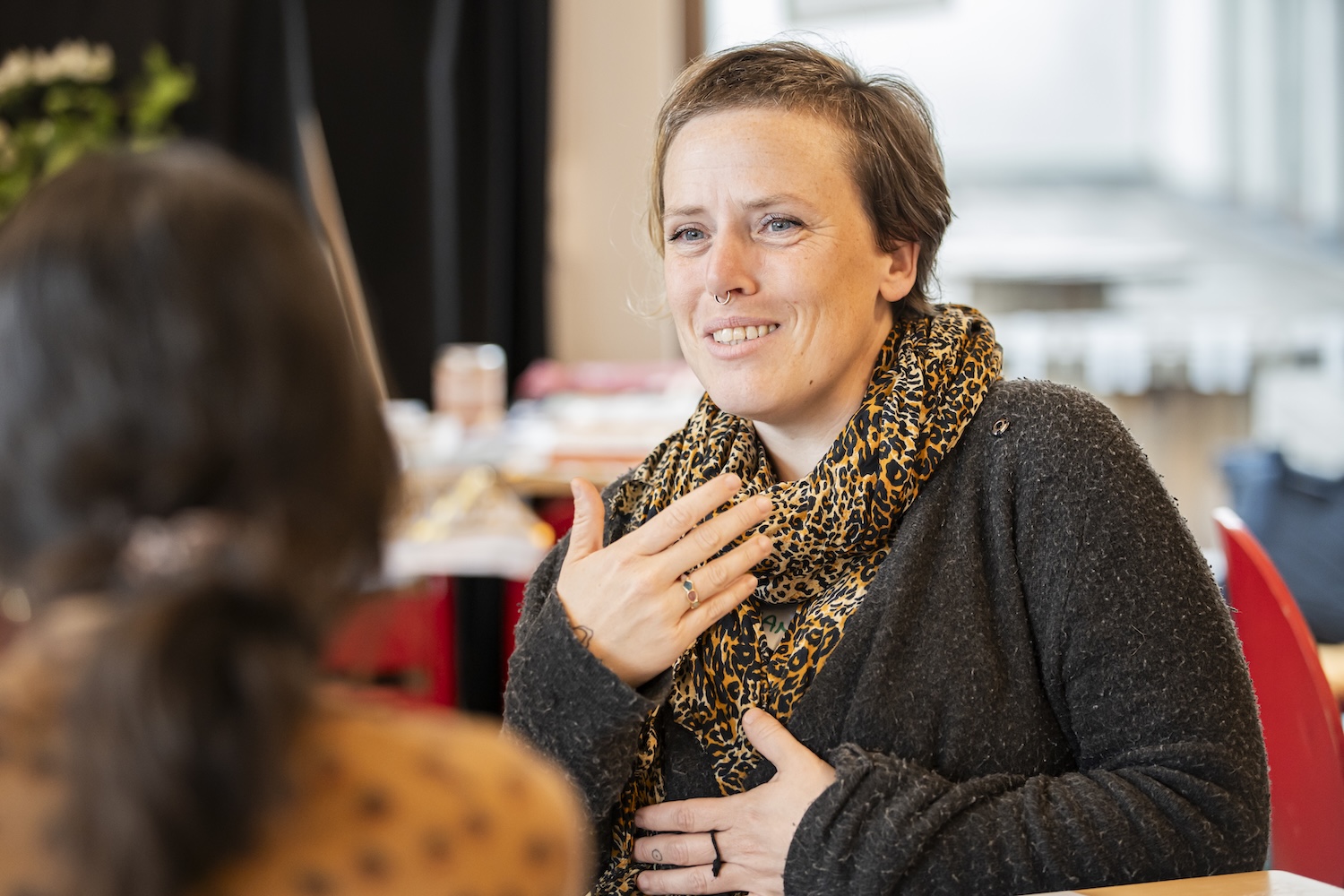
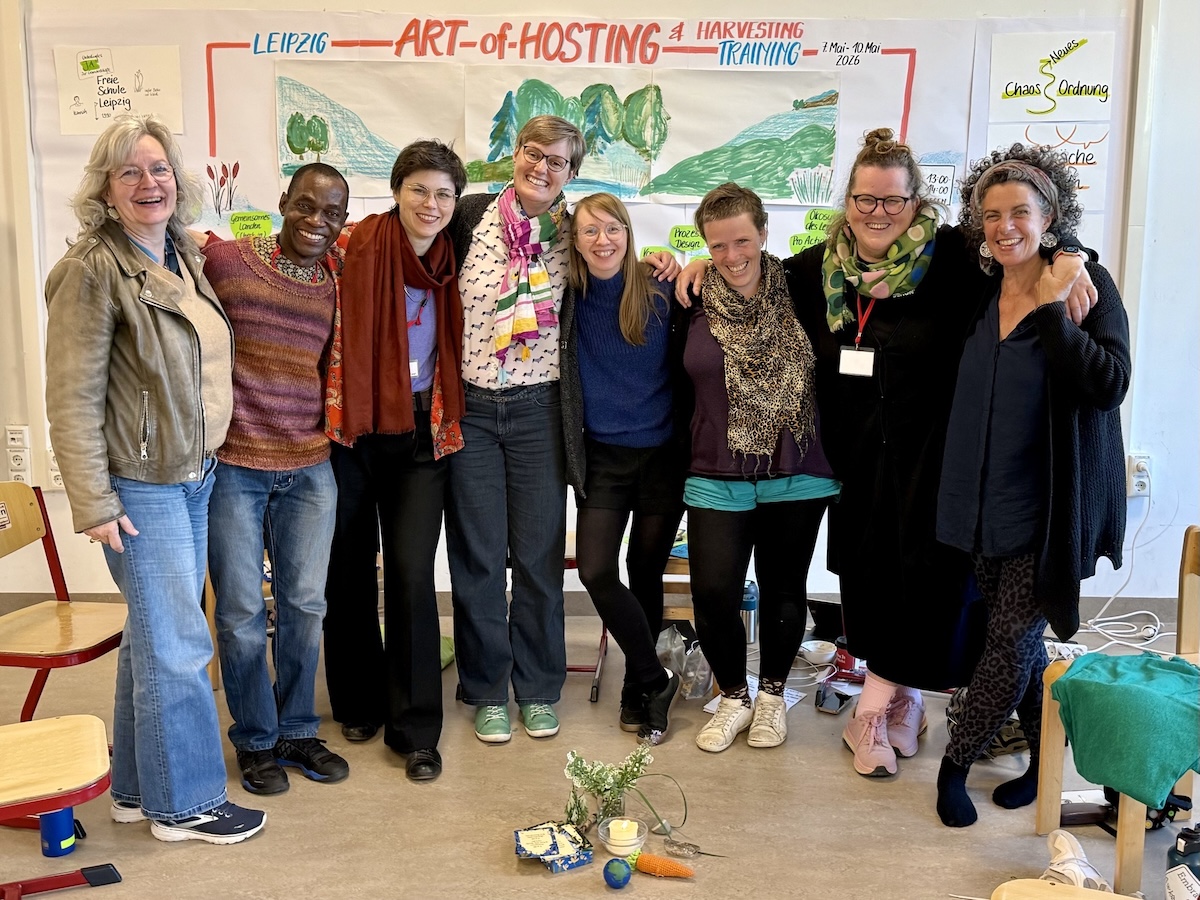
The venue as co-host, the team as a spider’s web
Two things underpinned this training session, which, in hindsight, are not discussed often enough.
Firstly: the place itself. A free school in a Grünau housing estate is not just a neutral conference venue. It makes a twofold statement: it is a place where, day in, day out, we practise the idea that learning can be self-directed and collaborative – right in the heart of a neighbourhood whose architecture and history tell a very different story of educational and social aspirations. This tension is embedded in the walls, and it played its part. Anyone looking out of the auditorium window saw not a backdrop, but the context of our Calling Question. The venue was a co-host – and our Local Host, Hannah, was the bridge: she knows the city, the stories, the neighbourhood. Without local roots, any training session remains a spaceship that lands and takes off again. With her, it becomes a knot in a fabric that endures.
Secondly: the hosting team. We deliberately formed a large team – large enough to maintain a truly stable container. With rotating roles: day hosting, individual hosting elements, and always someone to „hold it all together". A team that, over the course of our days working together, developed into a delicate yet incredibly stable spider’s web, visible only from certain angles. The participants don’t always see it – but they sense that it is holding everything together. And I ask myself: what were the main supporting threads that allowed this web to be woven in this way? What came together there – from the original call, through the months of preparation, and throughout these four days? What is it that we held so deeply?
I don’t have a definitive answer to that. But I do know this: adrienne maree brown is right when she says in Emergent Strategy writes that the small contains the large within it – fractally. The way we interacted with one another in the hosting team was, in itself, the sense of community we wanted to foster in the space. Small is beautiful, because it is the small that sets the pattern.
What you can take away: micro-practices
If I were to distil these four days down to what you can try out tomorrow in your own context – in a team meeting, at a workshop, or around the kitchen table – it would be this:
- Start with a question that grabs your attention. Not with an agenda. A ‘Calling Question’ has a certain pull; it is open, honest and concerns everyone in the room. Ask yourself: Would I come myself just for this question?
- Compare the differences side by side. Not every difference needs to lead to a conclusion. Sometimes simply acknowledging it – „that’s your truth, that’s mine, there’s room for both" – is the whole of the work.
- Take a moment before you sort them. Collective intelligence does not emerge when we pre-sort things – but when we are prepared to put up with a bit of chaos for a moment.
- The harvest is visible. A flipchart, a drawing, three sentences at the end: what was said, what has changed, what are we taking away from this? Without taking stock, even the best conversation will fade away.
- Host yourself first. Before you facilitate a session: How are you feeling? What do you need to be fully present? The most stable container begins within you.
- Share the burden. You don’t have to host the event on your own. Ask someone: „Will you help me keep things running whilst I lead the proceedings?" Two heads are better than one.
Forget-me-not
And then there is something else I don’t want to gloss over: we, too, have not answered all the questions, nor have we identified and examined all the tensions, nor given everything the attention it deserved. We have done a great deal, talked a great deal, and taken a great deal of action. And yes – at the same time, some things remained unsaid, unfinished, and unconsidered.
I have learnt not to see this as a failure, but as the very essence of the matter. A training programme that claims to be complete has probably not touched anything alive. The unfinished is an invitation to carry on. It goes on.
A few questions I’ve picked up in Leipzig and am passing on to you:
- Where do people live in your neighbourhood? side by side instead of with one another – and which discussion has never been hosted there?
- Which aspects of your own background do you hold back from sharing in professional settings? What would change if you shared more about yourself?
- What tensions within your team are you trying to smooth over – and what would happen if, instead, you acknowledged and embraced them?
- And: Where is your home a stranger to someone else – and vice versa? What can this difference teach you? And how can it bring you together?
Outlook: A network that continues to grow
„What will be the greatest "gain’ from Leipzig?” I was asked beforehand. I believe it will be a vibrant network of people, questions, ideas and energy that spreads conversations that bring people together across the world. An even greater sense of connection for what will be needed in the years to come.
Because that’s what it all comes down to in the end: It’s all about conversation. And what it makes possible. Not the perfect format, not the most impressive method – but the simple, radical experience that people with very different life stories, upbringings and wounds can spend four days together in one room and, in the end, leave feeling more connected than when they arrived. Not because they had reached a consensus. But because they had practised holding each other without clinging to one another.
Rumi was right: there is a place beyond right and wrong. In May 2026, it was on the top floor of a prefabricated block of flats in Leipzig-Grünau. And I’m sure it exists in far more places than we realise. We just need to start setting the table there.
If you’d like to get involved – as a participant, a local host, or a partner for a future Art of Hosting training – then please get in touch. I look forward to hearing from you, answering any questions, and seeing you again. And to whatever may emerge between us.
As a process facilitator at SOCIUS, Julia supports teams, organisations and networks – using the Art of Hosting, visual harvesting and a deep passion for conversations that make a difference. The next chapter may well be unfolding right now.
Sources & Further reading
- Steffen Mau: United yet unequal. Why the East remains different (Suhrkamp, 2024) – which also includes an analysis of the „phantom border": suhrkamp.de
- Robert Bosch Foundation & More in Common: A crisis in the relationship? Citizens and their democracy (Study, 2021) – Full text as a PDF
- Friedrich Ebert Foundation: Mitte Study – Analyses of democratic attitudes and the culture of dialogue: fes.de
- Othering & Belonging Institute, UC Berkeley: What is a sense of belonging?
- Judith E. Glaser: Conversational Intelligence: How Great Leaders Build Trust and Achieve Extraordinary Results (Bibliomotion, 2013) – The CreatingWE Institute
- Adrienne Maree Brown: Emergent Strategy: Shaping Change, Changing Worlds (AK Press, 2017) – adriennemareebrown.net as well as my blog post on this
- Vanessa Reid on the chaordic path: Video
- Jasmin Brückner: „Where I come from" & jasminbrueckner.de
 Deutsch
  English (UK)