
Praise from the cooperative
Praise from the cooperative
Why the registered cooperative as a legal form can do more than its reputation suggests
Why the registered cooperative as a legal form can do more than its reputation suggests
Author:in: Nicola Kriesel

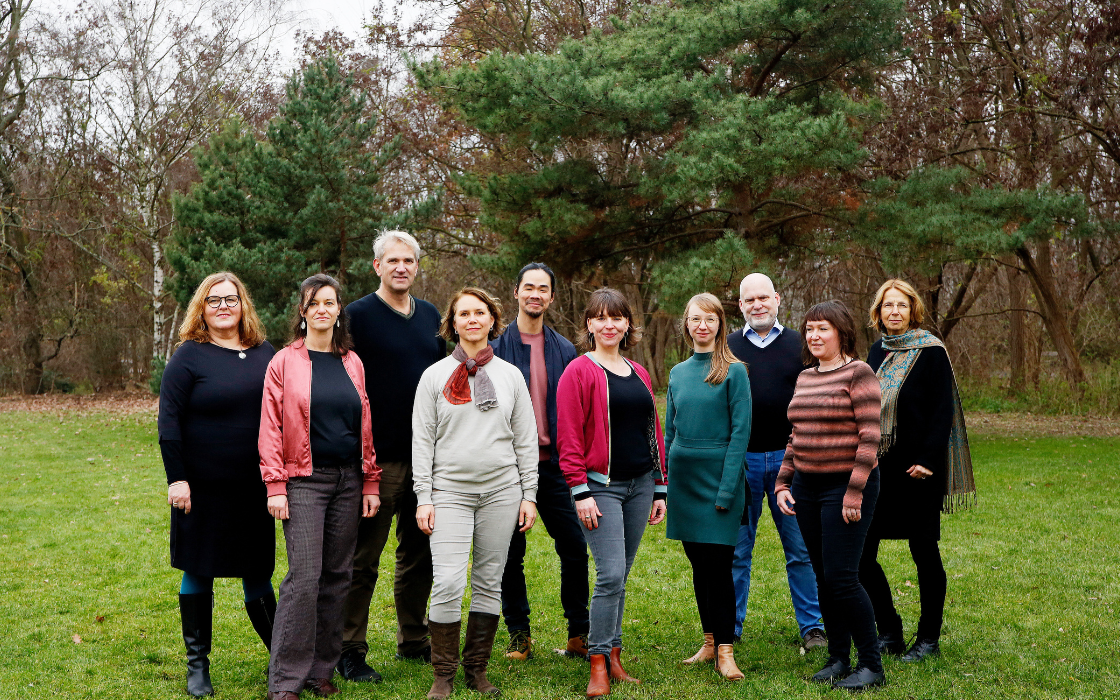
I have just become part of a founding group of people who want to build something together. Like many others, the group eventually came to the point where the usual legal form options didn't quite fit: the GmbH felt too much like a corporation. The association felt like a voluntary organisation. The gGmbH requires a charitable purpose, which not every community has or wants to have.
This is where the registered co-operative (eG) came into play. Initially hesitantly and with a slight shrug of the shoulders: Co-operative - isn't that something for housing projects and credit banks? But now we are working on the cooperative statutes.
At SOCIUS, we founded the eG in 2010 and somehow we haven't talked about it publicly for a long time. That can change now.
A legal form with history and attitude
The co-operative emerged in the 19th century as an answer to a specific social question: how can people who have no opportunities on their own achieve economic empowerment together? Friedrich Wilhelm Raiffeisen and Hermann Schulze-Delitzsch developed the idea independently of each other - as a self-help instrument for farmers, craftsmen and small traders who were excluded from the emerging capital market.
What was radical at the time is still structurally remarkable today: the cooperative is not primarily geared towards a return on capital, but towards the benefit of its members. This is called the promotion principle and is enshrined in the articles of association, not just as a declaration of intent: the eG does business for the benefit of its members. for their members.
The three fundamental principles - self-help, self-responsibility and self-administration - describe very precisely what distinguishes a cooperative from other legal forms. Self-help is the good old “Together we are strong! ”. Self-responsibility means that members not only have rights, but also genuine co-responsibility. And self-administration means that the decision-making authority lies with the members - not with external investors, not with a dominant shareholder.
Democratic structure as a statutory issue
What many people don't realise: In its basic structure, the eG is one of the most democratic forms of company in German law. This is not due to a particular culture or attitude of its founders, but to a very specific legal regulation: The general meeting is governed by the principle of one member, one vote - regardless of the amount of the cooperative share contributed.
This fundamentally distinguishes the eG from the GmbH, in which voting rights are linked to shares. Whoever has contributed more capital has more say. This is not fundamentally wrong - but it means that economic power and decision-making power structurally coincide. In the cooperative, this is decoupled. Whoever is a member counts the same - regardless of the shares they have contributed.
For organisations that really want to share decision-making authority, this is no small matter. It is the structural basis for ensuring that shared leadership not only exists as a cultural project, but is legally anchored.
The mandatory bodies of the eG (Executive Board and General Meeting as well as the Supervisory Board if there are more than 20 members) create a kind of separation of powers. The Executive Board manages operations. The Supervisory Board monitors and advises. The general meeting decides on fundamental issues. What sounds a bit like bureaucratic overload is in practice a helpful structuring of roles and responsibilities, especially when a community wants to organise decision-making processes more clearly without falling into hierarchy. For the security-conscious among us, the auditing association, to which a cooperative must belong, plays a good role here, as it monitors compliance with the formal internal processes from the outside in the sense of self-administration.
Sociocracy, shared leadership and the cooperative - a structural relationship
Anyone studying sociocracy will find something familiar in the co-operative structure. Both approaches share the basic idea that decision-making authority should not be tied to individuals or capital, but to the community of those who are affected by decisions and bear responsibility for them.
In the sociocracy, this is done via circles and roles, via the consensus principle and the double link. In the co-operative, it happens via bodies and membership, via statutes and the general assembly. The mechanisms are different, but the attitude behind them is similar: nobody should be able to determine the whole alone. Decisions are made through negotiation, not hierarchy. And that is why so many cooperatives are organised sociocratically. It simply fits together.
Shared and joint management, which is also important to us at SOCIUS, finds its institutional form in a sociocratic eG. This does not mean that everyone decides everything, but that management responsibility is structurally distributed across several shoulders and that no one can be forced out of this distribution by the amount of their own capital share.
At SOCIUS, we have been implementing this very directly since 2018: We are seven board members and one simple cooperative member, because that's what it takes. That sounds unwieldy at first glance, but in practice it's not at all. It means that we really share the legal responsibility for the whole, and delegate responsibilities, operational management and decisions through the sociocratic principles. What I appreciate about it is the certainty that the others are just as concerned about the well-being of SOCIUS as I am. We really are all in it together. (And have already learnt that you can also get out again).
What still surprises me sometimes - and I say this with a smile - is that the others look after things differently to me. And of course I realise that this is self-evident, but anyone who knows what it means to work with shared responsibility also knows that this realisation comes back regularly and that understanding is therefore always needed.
What the legal form enables - and what it does not regulate
The co-operative law provides the structure, the culture must be developed through practice.
At SOCIUS, we have worked a lot over the years on how membership of the cooperative is organised. Andi likes to talk about the 37 gates of belonging that have to be crossed - I don't know if he's ever counted them, but he's not wrong: becoming a member of SOCIUS is not a quick process. We take our time to get to know each other, we don't believe so much in application procedures but more in shared work experience, and we want people to really get involved in the shared principles. At the same time, it is not entirely trivial to take on responsibility for an eG.
We are currently very much enjoying the shared responsibility, the low-hierarchy working environment and the full commitment from everyone. At the same time, we realise that for many of those around us, the image of complete, exclusive membership no longer corresponds to the reality of their lives. NextWerk and the core team, contributors and members: the boundaries between “inside and outside” have become more fluid, and that's a good thing.
At the same time, the cooperative is very clear in its legal character: it serves its members. It provides a basic democratic structure for decision-making and responsibility; how broadly or narrowly membership is defined, how permeable or firm the boundaries of the community are - that remains a design task, not a question of the articles of association.
Who should take a look?
The eG is not a panacea and not a model for every organisation. There are other models for individual founders, for companies with classic investor logic or for purely voluntary structures.
But for communities that are serious about doing business together, that see decision-making autonomy not just as a cultural project but as a structural principle, that share leadership and do not want to be dependent on goodwill, it is worth taking a look at the co-operative. After all, it is the oldest institutional answer to the question of how economic empowerment and democratic action can go together.
 Deutsch
  English (UK)