


Everything will unfold with more grace if we stop trying to control and instead choose to simply sense and respond.
(Frederic Laloux, Reinventing Organisations)
There is a fine line between „not always just reacting to the environment“ and „not just planning for the drawer again“ in strategy work. The latest contribution to the discourse by Laloux Concept of „Sense & Respond“ describes a mode between these two extremes. It is neither clearly defined nor consistent – but it exudes the aura of a contemporary epochal headline.
The organisation's peripheral field of vision
In Sense & Respond mode, resonances with internal and external dynamics that are just emerging are sought. It is about seizing a future whose seeds are becoming visible in the here and now. This Feeling into the world is anything but trivial: as we know, we often filter out anything new or unsuitable through selective perception or interpret it through filters that fit our mental models. When I read the newspaper, there is a high chance that I will find and remember things that fit my view of the world. I quickly skip over anything unsuitable or reinterpret it. In the strategic process, „weak signals“ that flash up as harbingers of major developments in the noise of the world are also subject to these filters and distortions. We have to consciously seek them out – even at the edges of our field of vision.
This search can be supported, for example, by cultivating Networking as an extended perception interface – training the organisation's peripheral vision, so to speak. To do this, the network must first be informed about the type of signals the organisation is interested in and where such information can be sent. Cognitive filters can also be structurally balanced, for example by systematically contrasting the perspectives and interpretations of different observers. Another way is to approach the signals with as unobstructed intuition as possible, as Otto Scharmer describes in his presencing approach.
However, sensing does not only refer to signals from the environment, but also to the Feeling the social interior, on mindfulness for impulses and developments within the organisation. Where are new ideas and courses of action emerging? Who has just discovered something significant? Where is there potential for focusing attention (oh, the most valuable resource of our time...)? How sensitive and synchronised the response to such dynamics is has something to do with the jazz improvisation skills and teamwork of the members: listening, going with the flow and setting your own impulses – all of this contributes to successful emergent development and cannot be taken for granted. Laloux's concept of evolutionary sense describes how, with such mindfulness and the structural permission to make directional decisions not only at the top but in every part of the organisation, the „bigger picture“ of strategic lines emerges in a joint process. Planning and implementation are no longer separate processes, but interwoven. Meaning emerges as we go along.
As with the open space approach, I ask myself: Is this still strategic? And if not, is that a bad thing? Hasn't the discovery of mindfulness heralded a post-strategic era in which life is good? When an organisation asks me to accompany a strategy process, my first question is why they need a strategy in the first place. This question often elicits a mixture of shrugs and raised eyebrows: strategy is just something you need. Oh, really? If strategy is really just a pattern in the stream of decisions, then there's no need to think ahead – it emerges on its own. The eyebrow remains raised and I realise that this interpretation is not enough for me either. I don't just want to discover the world and drift with it, I also want to shape it. The big picture needs a canvas. So some ingredient is still missing. Could it perhaps be a little evolutionary and a little classical? What could compass performance and minimal control look like in sense and respond mode?
Navigation by probing
First, it is worth taking a look at the context. Contexts have more or less perceptible orders, each of which requires different forms of navigation. A helpful map for this is provided by the Cynefin Framework, which describes four orders:
- simple systems (simple rules of order, example: a toaster),
- Complex systems (multilayered rules of order, example: a computer),
- complex systems (dynamically overlapping rules of order, example: a forest) and
- Chaotic systems (opaque rules of order that do not allow for predictions, example: um... a children's birthday party with 9-year-old boys).
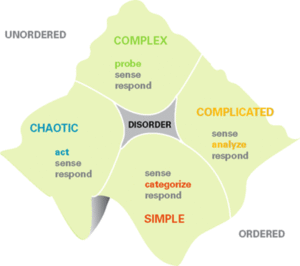
Source: Snowden & Boone, Harvard Business Review, November 2007
Even though complex environments currently exert the greatest fascination, invoking the VUCA world cannot hide the fact that life has always been dynamic and complex. The ingredients Volatility, uncertainty, complexity and ambiguity are an apt description of the world itself, with or without its progressive densification and acceleration. They mark the difference between the (simplistic static) map and the (complex dynamic) terrain. In this respect, we are currently dealing primarily with the long-overdue collapse of the modern delusion of controllability.
The Cynefin Framework can be used, among other things, for the differentiated indication of strategic approaches. According to Snowden & Boone (a must-read!), erfordern Complex environments For example, a strategic approach that replaces the classic analytical approach („sense-analyse-respond“) with experimental trial and error through probing and trial balloons („probe-sense-respond“). In chaotic contexts, on the other hand, robust action with ongoing observation of its interactions is appropriate („Act-Sense-Respond“). This fits with the insight that complex strategies only work in simple contexts, while complex environments require equally complex internal worlds but rules of action that are as simple as possible.
I read this, think it's great, and wonder how I can picture it now. What exactly are we going to do at the next strategy meeting? And will there be a plan at the end or not?
The art of three-quarters openness
To make progress here, it is worth looking at models that combine a high degree of openness with minimal strategic anchoring. They are not particularly common, but are gaining ground (as a signal that is no longer quite so weak). In the October 2016 service letter, we already discussed the approach of Opportunity-oriented development(opportunity driven development) according to Peter Skat-Rördam. He focuses on the question of what developments are needed to enable the organisation to recognise and exploit a relevant section of the opportunities in its environment in line with its „strategic intent“. The broad outlines therefore do not refer to the outside, but to the inside of the organisation. Strategy work thus becomes organisational development and continuous refinement of the functions of sensing and responding.
Another three-quarters open model is the approach taken by Guided evolution considered by Lechner & Bär. Here, strategic initiatives are launched in a continuous experimental mode and selectively reinforced or weakened. Developmental impulses are guided through three phases in a structured manner: „variation“ (generating new ideas), „selection“ (filtering promising approaches) and „retention“ (anchoring successful models through resource allocation, or dampening unsuccessful models). As in Laloux's image of evolutionary purpose, initiatives and impulses can arise at any point in the organisation. However, selection and control are classically localised in a strategic instance and are not dispersive.
The exciting question now is what evolutionary strategy can offer. organisational requirements What exactly are the „dynamic capabilities“ that allow organisations to change their strategic responses, perhaps even their resource base and business models, on the fly? Three things stand out: First, a high degree of „real-time communication“ is necessary, i.e., interaction that is as direct as possible with short response and feedback times (this does not always have to be face-to-face, but can also be communicated intelligently via media). Jazz improvisation without immediacy does not really work. Secondly, evolutionary strategies require cultures that are open to experimentation, in which bold and sensitive action are equally encouraged. Space for playful freedom, tolerance of mistakes, fluid changes in leadership and followership – these things also need to be learned. Thirdly, structures that can be quickly reconfigured are required. Thanks to the discourse on networks and agility, various models are now available for this purpose – from elastic framework structures („semi-structures“) and dynamic role boards to modular building block systems based on the Lego model.
And yet again, buzzwords... As far as I can see, the real work is only just beginning. It may well be that there are no more useful model recipes from here on, but that the appropriate form of strategy practice must be developed individually. It seems to me that the greatest challenge of the Sense and Respond mode is neither procedural nor structural, but has something to do with what developmental psychology calls „basic trust“.
Literature
- Frederic Laloux, (2015): Reinventing Organisations: A Guide to Creating Meaningful Forms of Collaboration, Vahlen.
- Snowden & Boone (2007): „A Leader's Framework for Decision Making“. Harvard Business Review, Nov 2007
- Schoemaker, P.J.H. and Day, G.S., (2009): „How to make sense of weak signals“ from Sloan Management Review 50 80-89, Cambridge, Mass.: Massachusetts Institute of Technology
- Peter Skat-Rördam (1999): Changing Strategic Direction: Practical Insights into Opportunity Driven Business Development Copenhagen Business School Press
- Lechner, Christoph & Bär, Lukas (2008) Guided evolution – strategy work in times of increased uncertainty. Scorecard: the themed magazine for executives, (2). 12–13.

 Deutsch
  English (UK)