
Self-organisation through dance
Self-organisation through dance
A look back at the SOCIUS lab „Organisations in Motion” in Leipzig
A look back at the SOCIUS lab „Organisations in Motion” in Leipzig
Author: Wera Stein

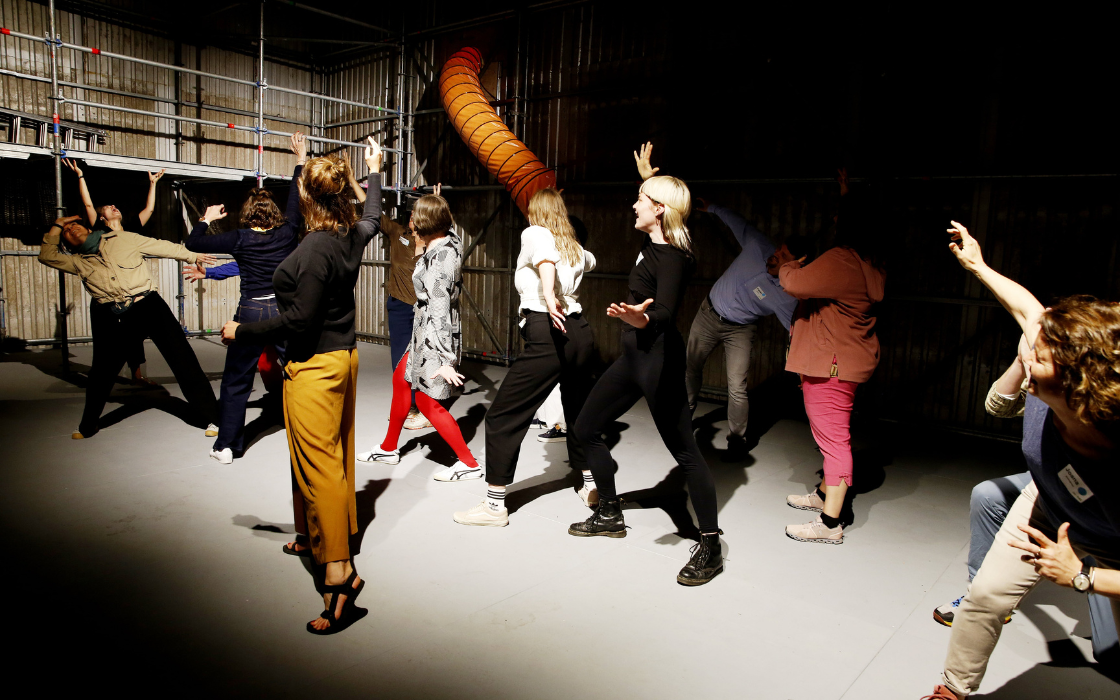
What can we learn from dance about counselling, leadership and transformation?
This question has been on my mind for a long time. And so has the counter-question: what can those working in the dance sector learn about organisational structure and culture? In September 2026, Lysan and I created a public space for the first time to explore precisely that. This article is not a final conclusion, but rather a reflection along the way.
Contemporary dance – what is it, and can I take part?
People often ask this question when I say that I learn a great deal about organisational development through contemporary dance. To put it simply, I describe it like this: many people think of dance as partner dancing, ballet or a show. This involves mastering rhythm and set sequences of steps, or overcoming the body’s limitations and the force of gravity – things the audience admires. Form comes first, and the body conforms to it. Within the group, everyone is expected to act as uniformly as possible. The individual does not feature, or is reserved for the star.
In contemporary dance, it’s the other way round. The body comes first; form arises from it. It works with, rather than against, gravity. Movement should be authentic and tell a story that the audience recognises from their own experiences and which moves them. Within the group, the focus is on connection, belonging and the sense of community amongst individuals.
For me, contemporary dance is therefore very closely linked to the principles of democracy and regeneration, which we as groups also seek to pursue or practise, both culturally and structurally, within organisations. Although dance and organisational consultancy are generally regarded as two distinct fields, I sense useful overlaps and connections between them. Where exactly do these lie? And where must boundaries be maintained?
So yes, anyone who is curious about the topic is welcome to take part in this research space. All levels and all body types are welcome.
The laboratory for researching dance methods
I usually begin my workshops by addressing the participants’ own topics, so that we can explore them in depth using a specific method. This time, I’m turning that approach on its head. We’ll try out approaches that are familiar to me from my work in dance, and explore which themes from the field of organisational development emerge from them. The workshop is divided into three parts, each focusing on the individual and the group.
Part 1: Principles and rules shape cultural practice
At the start of every seminar, I set the tone by outlining a few rules that we agree upon for the time we spend together – rules that are, in fact, self-evident, but which are subconsciously renegotiated time and again. They serve as an invitation, providing guidance and reassurance.
In this workshop, for the first time, I am setting out the principles that I take for granted as a dancer, and placing them at the very beginning. These include the following:
- Give and Receive: Everyone gives a little of themselves and takes a little from others. We’re allowed to watch one another. We’re allowed to copy one another. For example, if the person next to me is swinging their arm, I want to have a go at that too. Then go ahead and do it, adapting it however you like.
- Dealing with boundaries and resistance in a supportive manner: Every (dancing) person knows the feeling: the guided exercise isn’t fun or is stressful. It’s embarrassing, boring, complicated or whatever. Acknowledge this and take it seriously. Develop strategies and decide how you can adapt it to suit you. For example, you could do just part of it, add something of your own, shift the focus, or step out of it for a moment and rejoin as soon as the urge strikes.
- Contemporary dance utilises three levels: Spaces are defined by appropriate movements. On the grass, I’m allowed to lie down; on the bus, I can sit or stand; in a group, I can raise my hand. In some organisations, people only speak whilst seated at a table; in others, everyone sits on the floor in a circle. And in the dance studio, we usually use three levels: the low one close to the floor, the middle one and the high one. Some of you will lie down on the floor straight away; others may never have done this before. Try out which codes you’re familiar with and which ones you’d like to try for the first time.
- Enjoy the process. And have fun. 🙂
During the warm-up, with simple movements such as shaking or loosening up our joints, we try this out straight away. And we gain our first powerful experiences, which will stay with us later on, such as
„I was only there for myself and just wanted to be there for myself – or so I thought. But I was also inspired by the things around me. That was “Give & Receive’ on a very small scale.”
„When I saw two other people on the ground, I allowed myself to do the same.“
„There was a brief moment when I felt ashamed. What I do can be seen. I am seen, and I see others. How often does this happen to me as a reflex in everyday life? Here, I was able to become consciously aware of it and let it go.“
„I was able to follow my own path, just as everyone else follows theirs. For me, that was empowerment.“
These wonderful sentences reinforce my own experience: what we practise physically changes the way we think, make decisions and act within groups. It shows just how important these spaces for experience are. How can these principles be embedded within organisations even without external dance practice?
Part 2: The swarm has a choreographic leader
In the ‘Swarm’, the group moves together across the room in one direction. The vorder person leads until they turn round, bringing a new person to the front. To make the scene more interesting, we’ll add two further elements. Firstly, a gesture introduced by the vorder person, which everyone else copies. Furthermore, a person at the back may make a contrasting movement, which suddenly enriches the scene and the narrative considerably.
In the subsequent reflection, various levels are discussed:
- Structural guidelines and their implementation: It is important to stay close together and form a single unit facing outwards, like a membrane. How does the change of direction work? At exactly what moment does the lead change? What variations are there in the handover – from a sudden, direct handover to a slow, gradual one?
- Strategies as a team and a shared culture: Everyone shares responsibility for making it work. How playfully do we approach this, whilst remaining flexible yet clear? How do we manage closeness and distance?
- Personal strategies: How do I feel when I’m in the lead? How can I switch between roles quickly? Do I contribute my own ideas?
The discussion focuses on leadership within self-organisation: who takes the lead, how do we hand over responsibility, and how clear are our signals? From my perspective, I’d like to add something the group doesn’t seem to have noticed: there was a form of „meta-leadership". From the outside, I could see what the formation needed – or rather, how I wanted it to look – and gave very direct instructions: „You’re spread out too wide; stay closer together." “Be clear in your decisions so that the others know what you’re doing.” That was the choreographic direction. It is direct, pursues a specific intention, views the group from the outside and is in constant dialogue with it. It is a role we can also take on when advising organisations.
Part 3: Unison as a rough set of rules
In unison, everyone moves in the same way and the structure is predetermined, even though, in the contemporary sense, each body performs it in their own way. Unison means forming a strong connection. However, this also requires good training and practice. In a short space of time, we learn a sequence of movements, taken from a real dance piece.
This reflection focuses on questions that also arise within organisations: How do we pass on information within an existing structure in our day-to-day work? How do I deal with it when I don’t understand something? How much structure is needed to allow for individual freedom?
In addition, the principles from Part 1 are applied. Who has drawn on which of them? And would they also be beneficial to us in the day-to-day cultural life of organisations?
How can we make use of dance-based approaches?
In my work to date supporting and advising organisations, I have drawn on various approaches from the field of dance, to which another has been added during the course of the workshop:
- As a fundamental democratic experience: being part of a group whilst still remaining true to oneself.
- As a space for experience and research into personal and cultural roots.
- On incorporating bodily awareness – perceiving oneself and others – and the ability to act on one’s impulses.
- As a subtle element to create atmosphere and bring transitions to life.
- As a way of looking at group dynamics, in order to interpret processes through the lens of choreography and approach them with greater composure.
- As choreographic director, with my own vision, an outside perspective, and in constant dialogue with and attention to the group.
Outlook
For many of those present, the workshop provided the initial impetus to pursue research in this direction, and there is a desire to continue along this path. The second workshop on „Organisations in Motion" will take place on 5 March 2027, 2 pm to 6 pm, ... We want to delve deeper into the role of choreographic direction and explore what this role might entail in the context of counselling and leadership.
Anyone who’d like to join us is very welcome!
We look forward to seeing both familiar and new faces at the gathering!
Lysan Escher and Wera Stein
 Deutsch
  English (UK)