
The Futures Triangle
The Futures Triangle
Shedding light on the range of plausible futures
Shedding light on the range of plausible futures
Author:in: Andi Knoth


„The future is not a fixed destination we are travelling to,
“but a space that we create’
Sohail Inayatullah
Thinking of the future in the plural is a bit of a stretch for the mind that is resigned to a linear course of events. But if we consider only the most likely scenario for future developments, and not their a dazzling realm of possibilities If we take this view, we might as well give up on shaping the future altogether and retreat to the defensive strategy of anticipation and adaptation. Futures, then – and, so as not to get bogged down, preferably: plausible futures.
One voice that is currently influencing the discourse on ‘futuring’ like no other is that of Sohail Inayatullah. With his roots in political science and macrohistory, this Queensland-based futurologist and think tank analyst (Metafuture) captures the spirit of these times of upheaval through his critical and transformative approach and his toolkit of the „Six Pillars of Futures Thinking“.
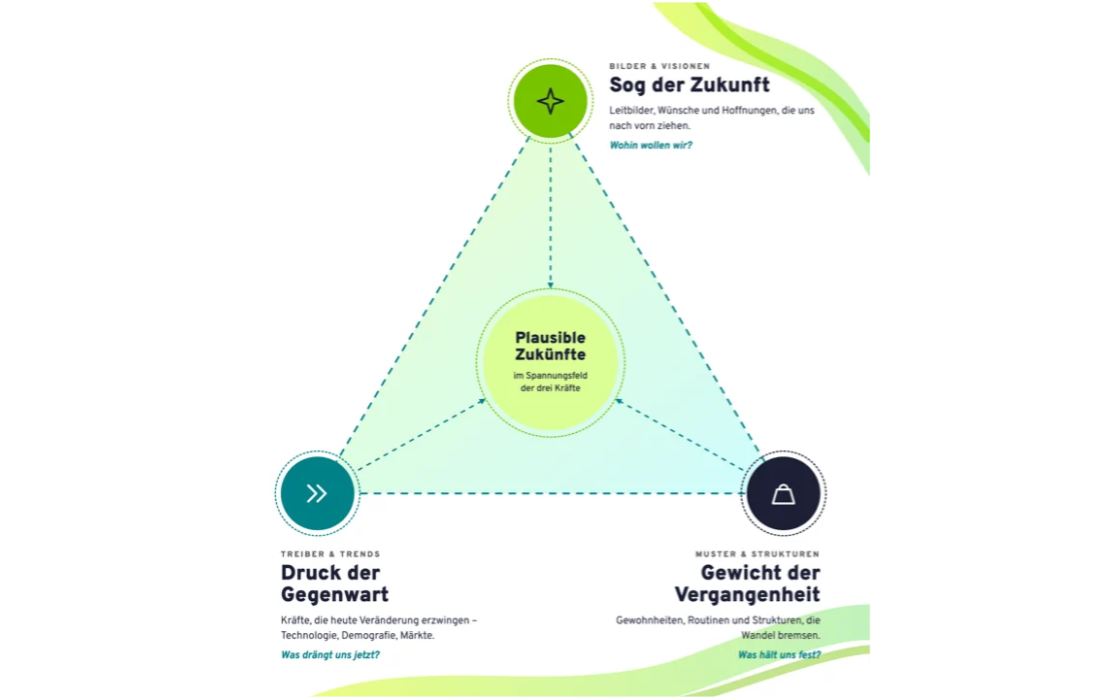
One very user-friendly mapping tool in this collection is the Futures Triangle. The model helps to visualise the forces that define the plausible future space within a social system. The triangle spans three reference points:
The ‘Push of the Present’ – which arises from the drivers and imperatives for change that we experience –,
the pull of the future, which arises from images and visions that draw us in, and
the weight of the past, the old habits, structures and patterns that hold us back.
According to Inaytullah, the future emerges in the The tension between these three forces. If you consider them together, you gain a better understanding of why change is sometimes easy and sometimes difficult, and where the key levers for change lie. If, for example, the weight of the past is very strong, the plausible path of development will naturally follow closely on from the status quo. Where the pull of the future is strong, more radical change is possible.
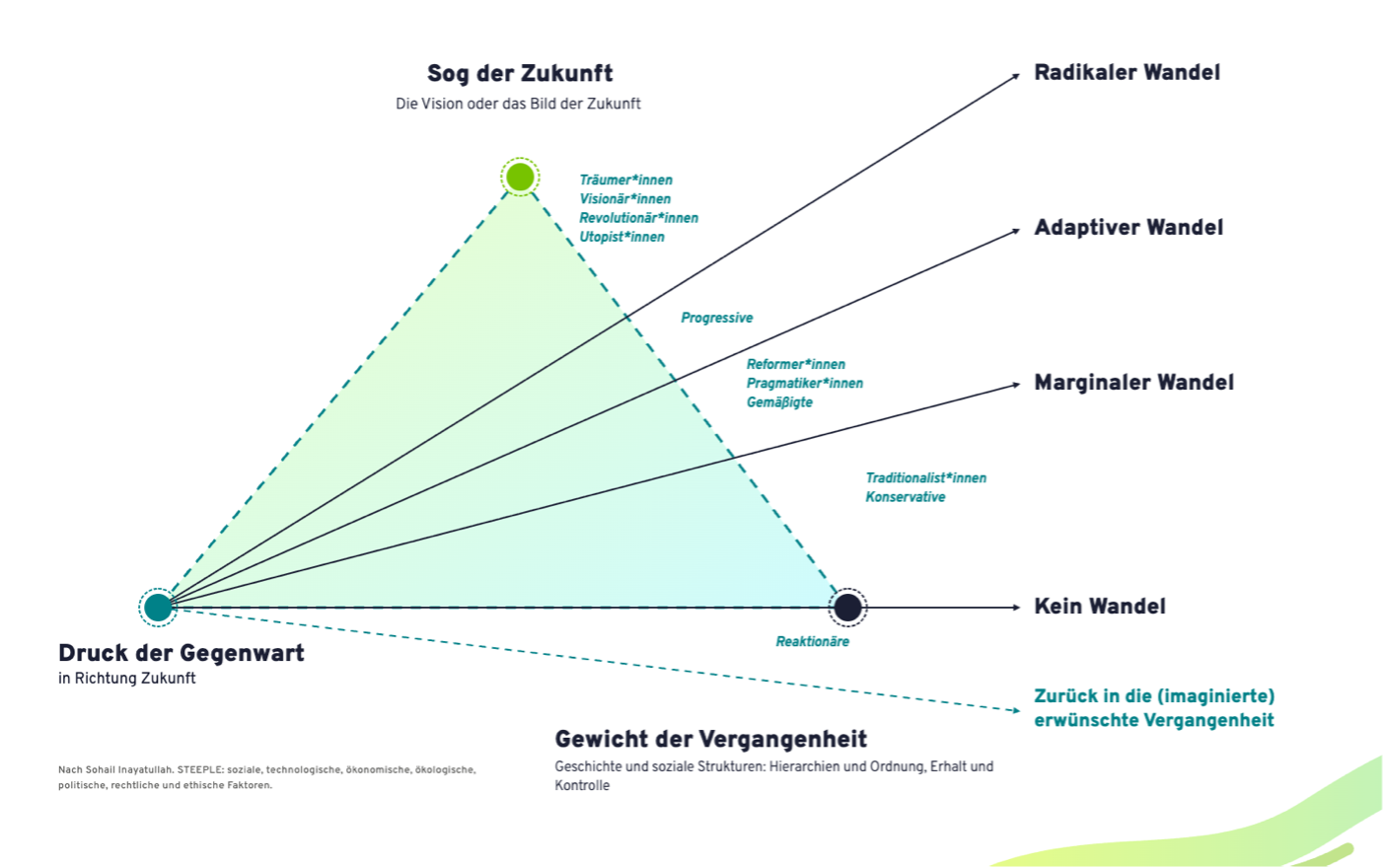
The Working with the triangle The workshop is intuitive: guided by three key questions – What compels us to act today? (Push), What draws us in? (Pull) and What holds us back? (Weight) – participants share stories in rotating World Café sessions and map influencing factors onto cards at the respective corners of the triangle. This overview of the forces at play creates the space to derive plausible futures and develop initial strategic proposals as the workshop progresses.
For me, the Futures Triangle is a nimble An introduction to strategic processes: It creates a common language, broadens one’s perspective to see the bigger picture, and combines visionary thinking with a pragmatic approach to the status quo. In particular, honestly exploring the „weight of the past“ often acts as an eye-opener for teams that would otherwise regularly struggle to implement strategies.
The model can also be used to good effect in organisational development – for example, as a methodological adaptation of the Beckhard’s formula for change (D×V×F>R). This somewhat cumbersome piece of organisational wisdom suggests that change only succeeds when the interplay of dissatisfaction, vision and first concrete steps outweighs resistance to change (see our Change Essentials cookery show here). The core components – dissatisfaction (Push), vision (Pull) and resistance (Weight) – can be neatly mapped onto the Futures Triangle. In this way, the triangle becomes a structured framework for dialogue on readiness for change, viable development paths within the field of forces, and the first steps on the OE journey. Further details on the method can be found in the article The Future Triangle – Origins and Iterations (Inayatullah 2023).
The Futures Triangle is just one of the tools in the „Six Pillars“ Futures toolkit. Perhaps the most profound method in the collection is the Causal Layer Analysis (CLA), a framework that reveals the deep-seated images and metaphors that shape our view of the present and the future, and where a shift towards something truly new also requires a transformation of these foundations. Inayatullah explains this ‘U-process’ of futuring as follows: „To change the future, we must first change the stories we tell ourselves about the present.“.
Anyone interested in these tools and the Critical Futures approach should keep an eye out over the coming year: at the end of April, we are inviting Sohail Inayatullah and his Metafutures partner Ivana Milojević for a Futures Thinking Masterclass and other events centred on the theme of imagination in Berlin.
 Deutsch
 English (UK)
